A genuinely future-ready education must develop something more durable: the ability to understand unfamiliar problems, question convenient answers, evaluate competing possibilities and make responsible decisions.
A sponsored Maclean’s feature about York University offers an interesting example of this approach. Students in York’s Entrepreneurship and Innovation program are using artificial intelligence and virtual reality to test ideas, challenge assumptions and refine their thinking before bringing those ideas into the real world (Mohammed, 2026).
The significance is not simply that York is using AI and VR. It is how the technologies are being positioned.
AI Can Suggest. Students Must Decide.
AI can produce an answer almost instantly. That can be enormously useful, but receiving an answer is not the same as understanding it.
York assistant professor Andrew Sarta describes an approach in which students augment their existing abilities with AI rather than surrendering the work of thinking to it. According to the Maclean’s feature, combining AI-supported analysis with VR simulation allows students to test more hypotheses, iterate more quickly and refine their thinking before acting (Mohammed, 2026).
That distinction matters.
If AI becomes a shortcut around thinking, it may improve the appearance of a student’s work without strengthening the student. If it is used as something to question, test and challenge, it can become part of a much richer learning process.
AI can make a recommendation. It cannot assume responsibility for that recommendation.
It can produce the answer. The learner must still understand what the answer means, determine whether it is credible and decide whether it should be used.
VR Makes the Problem Experiential
VR serves a different purpose.
AI can describe a problem, suggest alternatives or identify patterns. VR can place the learner inside a representation of that problem.
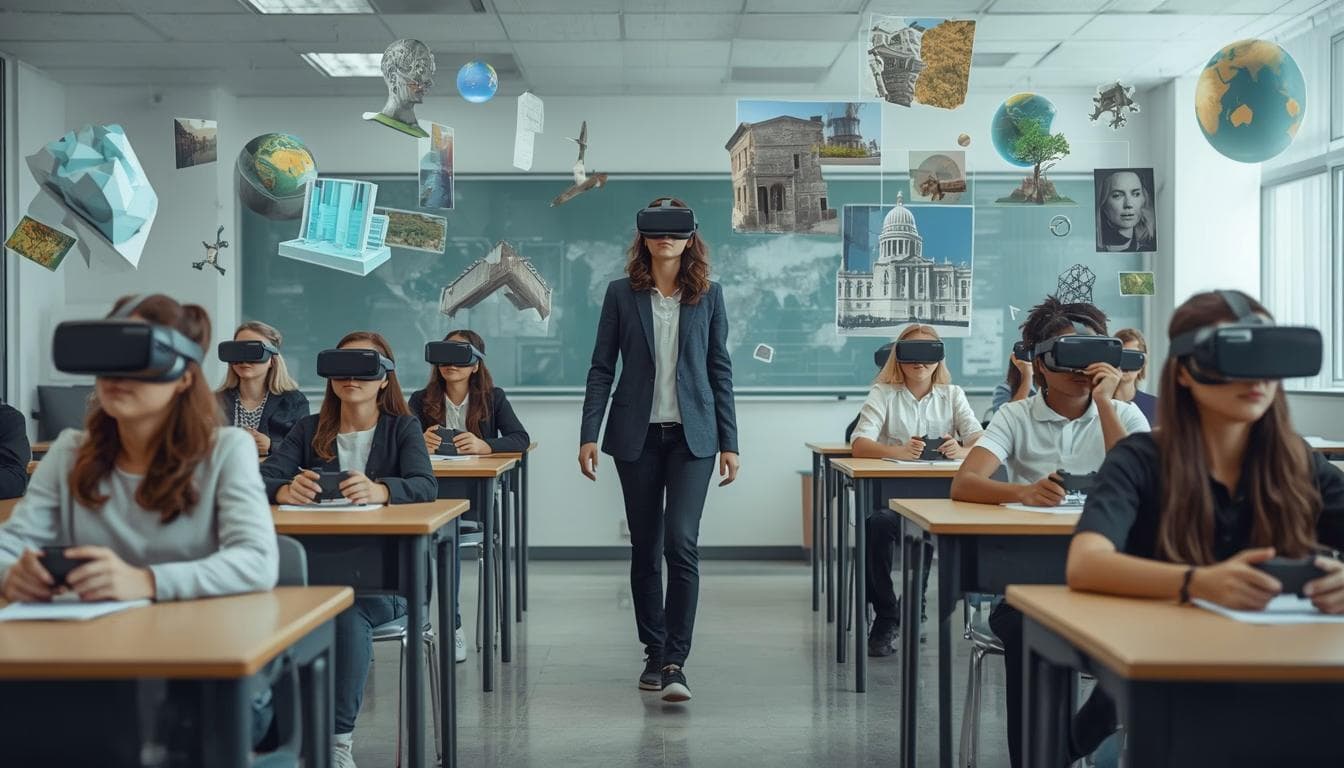
Instead of discussing a business or community challenge entirely in the abstract, students can examine a situation spatially, experience it from another perspective and observe how different decisions might affect the people involved. The Maclean’s feature describes York students using VR simulations as part of an iterative process of testing ideas and assumptions before applying them outside the classroom (Mohammed, 2026).
This reflects a broader principle of experiential education. York describes experiential learning as a way for students to connect academic theory with concrete experiences and real-world problems (York University, 2021).
VR can make that connection possible when the real experience would be dangerous, expensive, distant or impractical to reproduce. York has previously identified applications such as virtual welding, in which students can begin developing familiarity with the task without exposure to fumes or burns, before progressing to a physical workshop (York University School of Continuing Studies, 2022).
That does not make VR a replacement for real experience. It makes VR a bridge to it.
Understand First, Then Create
York’s approach also supports an important educational sequence: understand first, then create.
Students need opportunities to explore a subject before being expected to design something meaningful within it. They need to see the environment, examine the variables, recognize the human consequences and understand the problem from more than one perspective.
Only then should the technology ask them to create.
York’s own Curriculum in Virtual Reality program provides a useful example. It helps educators transform conventional assignments, such as essays and presentations, into VR deliverables while retaining the original learning outcomes. The objective is not merely to make an assignment look more technological. It is to engage students, introduce new methods of expression and explore different ways of learning (York University, n.d.).
That last condition is essential: the learning outcome must remain in control.
Creating a VR project can develop research, storytelling, spatial reasoning, collaboration and digital literacy. However, creation without sufficient understanding can become little more than technical decoration. Students should not be judged by how many features they use, but by how clearly their experience communicates an idea and serves its intended audience.
The Liberal Arts Are Not Obsolete
One of the strongest ideas in the Maclean’s feature is that the liberal arts should be treated as a launchpad rather than a fallback (Mohammed, 2026).
As AI becomes more capable, technical fluency will matter—but so will the ability to ask good questions.
Whose interests does this proposed solution serve? What assumptions are embedded within the AI’s answer? Who might be excluded? What information was collected? What are the unintended consequences? Is the most efficient answer also the most responsible one?
Those are not merely technical questions. They require history, ethics, communication, cultural understanding and human judgement.
The future will not belong only to people who know how to operate machines. It will also belong to people who can determine when those machines are wrong, inappropriate or being used to solve the wrong problem.
Technology Does Not Automatically Create Access
The York example is encouraging, but “future-proof education” must extend beyond well-equipped university programs.
A course may succeed with specialized facilities, dedicated technical support and individual access to sophisticated equipment. That does not mean the same model can be transferred directly into an ordinary school.
Schools must ask practical questions:
- Can every student participate?
- Does the system require constant internet access?
- What student information is being collected?
- Can teachers use it without becoming technical facilitators?
- Can the institution afford the complete system rather than just the headsets?
- Will the content remain available if a platform, subscription or device is discontinued?
These are not secondary implementation issues. They determine who receives the opportunity and whether the program survives.
A technology cannot future-proof learning if the school cannot sustainably use it in the present.
The Sensible Path Forward
At Sensible-VR, we see AI and VR as complementary technologies—but neither should control the learning process.
AI can help students consider possibilities. VR can help them experience ideas, environments and consequences. Students can then research, question, discuss, create and make the final decision.
The system does not need to be technologically extravagant. It needs to be purposeful, accessible and reliable. It should protect learners’ privacy, minimize demands on teachers and work within the financial and operational realities of education.
The goal is not to prepare students for one particular device, platform or AI model. It is to develop learners who can adapt when all of those things change.
That is what future-proofing should mean.
Not knowing which button to press.
Knowing why—and whether—it should be pressed at all.
Sources
Mohammed, J. (2026, May 29). How York students are putting AI and VR to work on the world’s biggest challenges. Maclean’s. Sponsored content for York University. https://macleans.ca/sponsored/the-future-proof-degree-york-university/
York University. (n.d.). CVRRICULUM program. https://www.yorku.ca/cvrprogram/
York University. (2021, October 20). Nearly every Markham Campus program to feature experiential education. https://www.yorku.ca/markham/2021/10/20/nearly-every-markham-campus-program-to-feature-experiential-education/
York University School of Continuing Studies. (2022, November 14). The future of experiential learning. https://continue.yorku.ca/the-future-of-experiential-learning/