When a teacher sends students to the library to read, do they run behind every student, watching which page they are on and trying to determine exactly where their eyes are looking?
Of course not.
We give learners space.
Yet with VR, there seems to be an assumption that teachers should be able to watch every student's experience in real time, sometimes with software that streams the contents of each headset to another screen.
Why?
The Observer Changes the Experience
One of VR's greatest educational advantages is its ability to create a distraction-free, judgement-free space in which a learner can concentrate on the task in front of them.
Continuous observation potentially changes that.
Research into what is often called the observer effect, or more broadly reactivity, has shown that people may change their behaviour when they know they are being watched. Studies of learners under direct observation have found that being watched can feel like being assessed and can cause people to alter how they normally perform.
That matters.
A student who hesitates inside VR may not need intervention. They may need five more seconds.
They may need to make the wrong decision, recognize it, reconsider it and try again. That process is learning.
If every hesitation becomes something visible to an instructor, diagnosed immediately and potentially acted upon, we risk removing something extremely valuable:
- the opportunity to struggle privately.
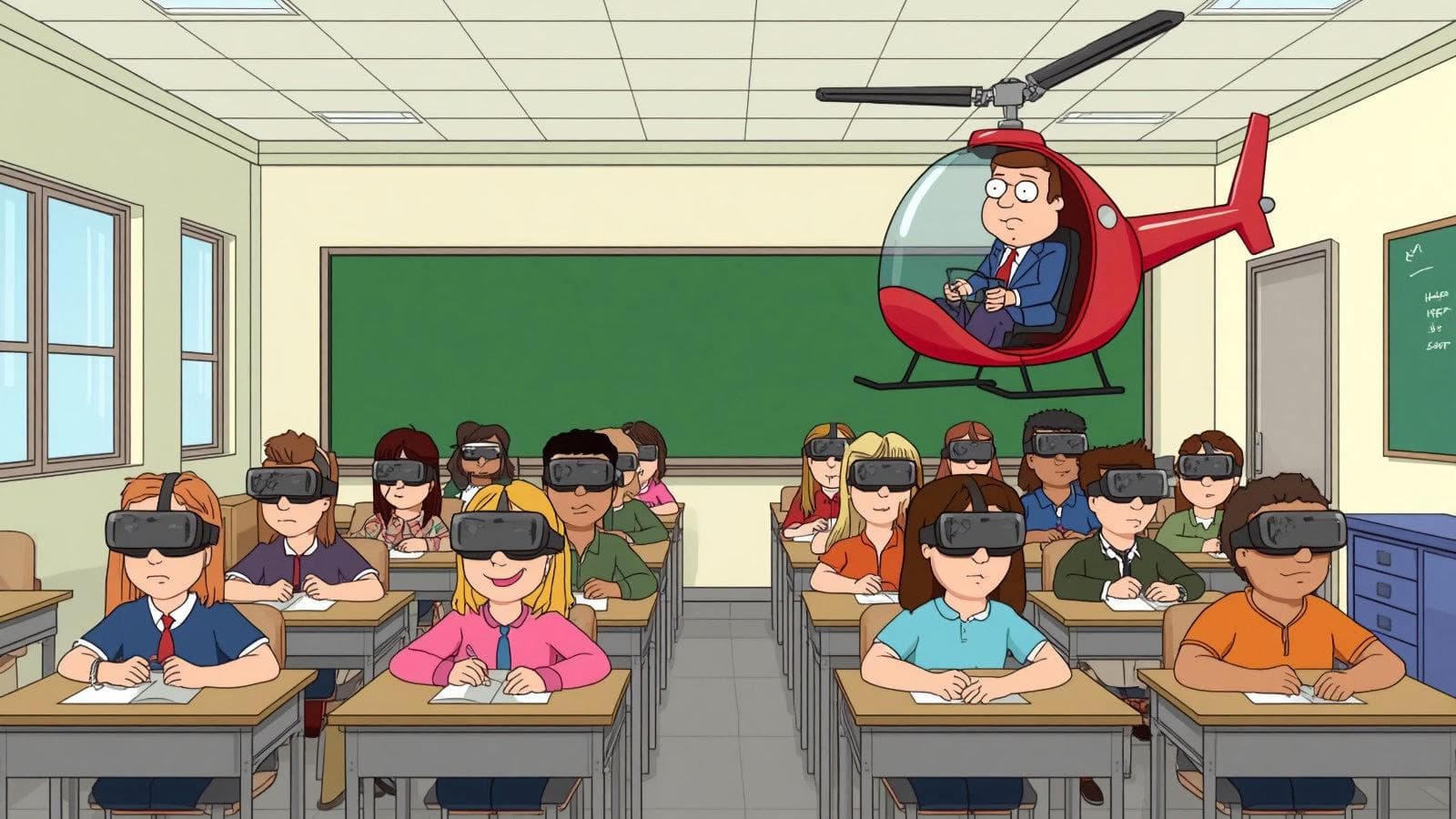
Are We Creating Helicopter Teachers?
We already recognize the problem of helicopter parenting, adults becoming so involved in children's experiences that they unintentionally reduce opportunities for independence, problem-solving, and resilience.
Education should be careful not to create the technological equivalent.
A teacher should be available to a learner without having to be permanently present inside the learner's experience.
There are certainly occasions when observation is necessary. Assessment, safety-critical training and diagnosing a specific difficulty may justify it.
But that is very different from making continuous surveillance the normal condition of learning. Just because technology allows us to watch does not mean education requires us to watch.
And Then There Is the Cost
Consider a remote-viewing system costing $150 per month.
That sounds fairly inexpensive. But, over five years:
$150 × 60 months = $9,000.
If a VR headset costs $900, that subscription represents the purchase price of ten additional headsets.
Now consider what those ten headsets could actually do.
At one 15-minute session every 15 minutes over six hours:
- 24 learning sessions per headset per day
- × 10 headsets × 180 school days × 5 years
That equals:
216,000 potential learning experiences.
That is the opportunity cost. Not $9,000.
Potentially 216,000 student learning experiences.
And that still does not include the Wi-Fi infrastructure, networking, configuration, troubleshooting, teacher attention and IT support required to keep a live monitoring system functioning.
The question therefore becomes much bigger than:
“Wouldn't it be useful if the teacher could see inside every headset?”
Of course it might be useful. The better question is:
Is it useful enough to justify what we give up to achieve it?
Sometimes Not Watching Is Part of the Design
VR does something unusual in education. It can place a learner alone with an idea.
- No classmates watching.
- No embarrassment when they hesitate.
- No need to look toward the teacher for approval.
- No notification appearing on another screen.
Just the learner and the experience. We should be very careful about designing that advantage back out of the technology.
- The goal should not be to make VR easier for adults to watch.
- The goal should be to make VR better for students to learn.
Sometimes good teaching means intervening.
Sometimes it means watching.
And sometimes it means having the confidence not to watch at all.
Sources
- LaDonna, K.A., Hatala, R., Lingard, L., Voyer, S. & Watling, C. (2017). “Staging a performance: learners’ perceptions about direct observation during residency.” Medical Education, 51(5), 498–510. The study found that learners generally valued direct observation, but that it could also create significant anxiety and a sense of performing for the observer.
Read the study at Wiley
PubMed record - Paradis, E. & Sutkin, G. (2017). “Beyond a good story: from Hawthorne Effect to reactivity in health professions education research.” Medical Education, 51(1), 31–39. This paper examines the idea that people alter their behaviour when observed and argues that “participant reactivity” is a more precise term than simply invoking the Hawthorne Effect. It also cautions that observer effects are complex rather than automatic.
Read the study at Wiley
PubMed record - Yoshida, T. (1991). “The effect of the observer on causal attribution and task performance.” The Japanese Journal of Experimental Social Psychology, 31(2), 104–109. Experimental research specifically examining how the presence of an observer can affect students’ task performance and behaviour.
Read the article on J-STAGE