
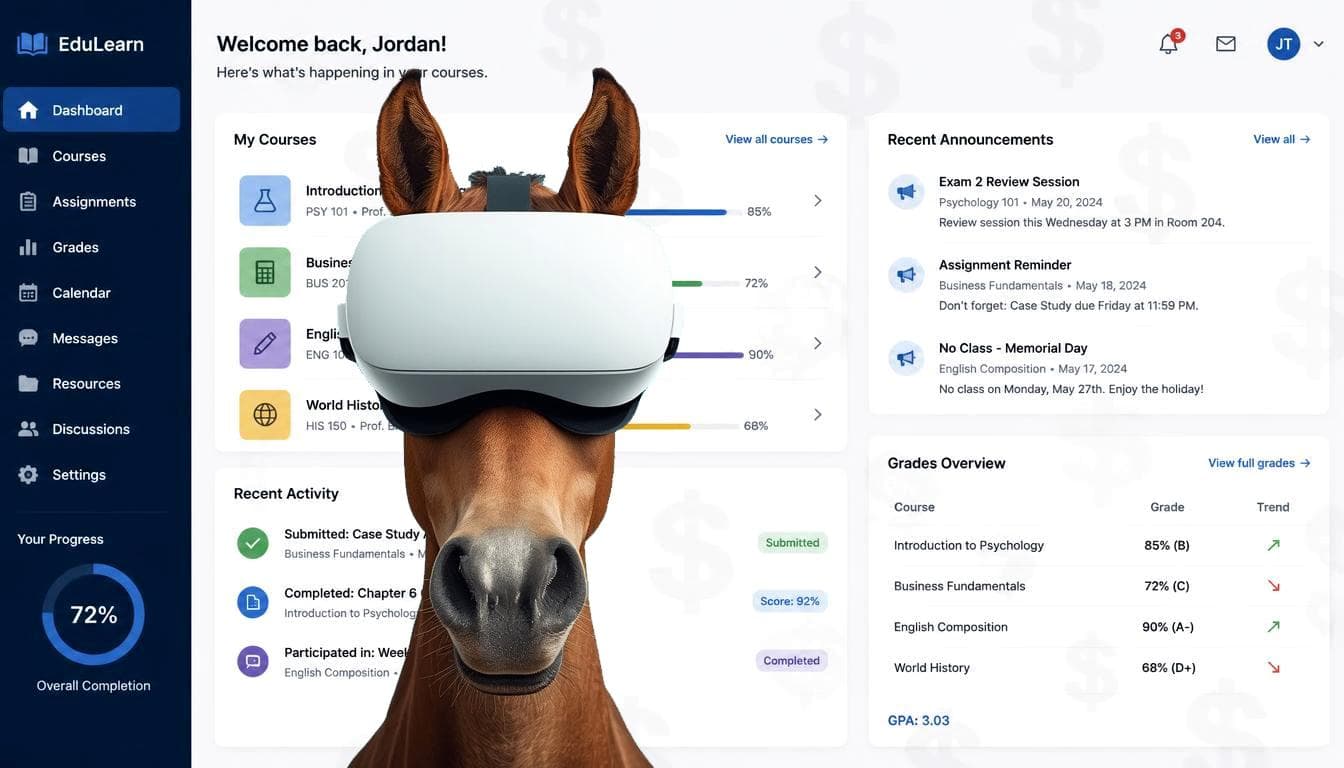
Where will the horse live? Who will feed it? What will the stable cost? Who will groom and train it? What happens when it needs veterinary care?
The horse may be free. Owning the horse is not.
In fact, a horse that comes with suitable stabling, feed, training and care—even at a substantial purchase price—may ultimately be far more affordable than the “free” horse.
Education has encountered this lesson before.
The Moodle lesson
When Moodle arrived, the prospect of a free, open-source learning management system excited many teachers and IT departments. And rightly so: Moodle removed software licensing fees and gave institutions considerable freedom to adapt the platform.
Moodle remains free to download, use and modify. But Moodle’s own documentation makes an important distinction. It describes the platform as free like a “free puppy” that needs care and attention, rather than something that carries no continuing responsibility.
A school implementing Moodle may still need to pay for:
- Servers or cloud hosting
- Installation and configuration
- Integration with student-information and authentication systems
- Custom development and branding
- Plugins and compatibility maintenance
- Security, backups and software updates
- Migration of existing courses and data
- Staff training and course development
- Technical support and ongoing administration
None of this makes Moodle a poor choice. Quite the opposite: it can be an excellent and highly cost-effective platform. If a commercial LMS costs $100,000 and a Moodle implementation costs $25,000, choosing Moodle may be a very sensible decision.
The lesson is not that “free” is bad. The lesson is that the acquisition price of one component does not tell us the cost of the complete working system. That’s TCO, the Total Cost of Ownership.
Moodle may be free software. A functioning Moodle implementation is not necessarily free.
Now apply that lesson to VR
Schools are often encouraged to begin their VR decisions with one question:
How much is the headset?
Sometimes the offer is even more attractive: the school may receive gaming headsets at a deep discount or at no charge.
That sounds compelling—just as the free horse does. But the headset is not the educational system. It is merely one component of it. The real question is what the school must add, change, buy and continually provide to make that hardware useful for learning.
A set of free gaming headsets can become one of the most expensive propositions a school faces.
The school may still have to account for:
- Professional development and repeated staff training
- Teacher or facilitator time for setup and supervision
- IT time for accounts, updates, troubleshooting and connectivity
- Mobile device management to distribute and control content
- Software licences and recurring subscriptions
- Wi-Fi capacity and dependence on online services
- Physical space and safety supervision for room-scale use
- Cleaning, charging, storage and controller management
- Replacement costs associated with short gaming-product cycles
- Workflow complexity that discourages everyday classroom use
- Privacy risks involving student accounts, activity or motion data
And after paying those costs, the school still has to reach the entire reason for buying VR in the first place: educational content.
That content must be suitable for the learners, connected to genuine learning objectives, simple for teachers to access and reliable enough to use during a real class. A headset without an appropriate content system is no more an educational solution than an empty school building is a curriculum.
Free to acquire can be expensive to operate
This is why purchase price is such a poor measure of value.
A headset may cost nothing but demand teacher supervision every time it is used. It may require annual training, third-party management software and constant IT involvement. It may expose student data to systems designed around consumer engagement rather than education. It may be replaced or unsupported according to a gaming-company product cycle that has little regard for school budgets.
Every one of those demands has a cost. Some appear on invoices. Others are absorbed through staff time, classroom disruption, underused equipment and devices sitting in cupboards.
The cheapest system on purchasing day can become the most expensive system over five years. More importantly, it can fail to deliver enough learning to justify any price at all.
Pay for the horse that comes with what it needs
Imagine two offers.
The first horse is free, but you must separately arrange its stable, feed, grooming, training and medical care.
The second horse has a price, but that price includes the facilities, care and support needed to keep it healthy and useful.
Which horse costs less?
You cannot know by comparing their purchase prices. You must compare the complete responsibility attached to each one.
Educational VR should be evaluated in exactly the same way. Schools should ask:
- Is the content already included and ready to use?
- Can the system work reliably without constant internet access?
- How much teacher supervision does it require?
- How much IT administration does it create?
- Are additional platforms, subscriptions or management systems required?
- How long will the hardware and content remain usable?
- What student data is collected, and why?
- Can teachers use it confidently without becoming VR technicians?
- What will the complete system cost over five years?
Those questions reveal far more than the price of the headset.
Look the gift headset in the mouth
A free horse may be wonderful—if you already have the stable, knowledge, time and resources to care for it. Moodle may be an excellent choice—if its complete implementation costs and responsibilities are understood. A free headset may also have value—if it fits a properly designed educational system.
But if an educational VR offer places undue constraints on the school, requires professional development and support year after year, increases supervision, depends on added management platforms, exposes student data and follows a short gaming-product cycle, receiving the headset for free should not end the evaluation.
It should begin it.
And sometimes, when the free offer carries too many expensive obligations, the most sensible response is to run in the other direction.
Source
Moodle confirms that its open-source LMS carries no licensing fees while noting that organisations can incur hosting, maintenance and training costs. See Moodle’s official FAQ and Moodle services.