
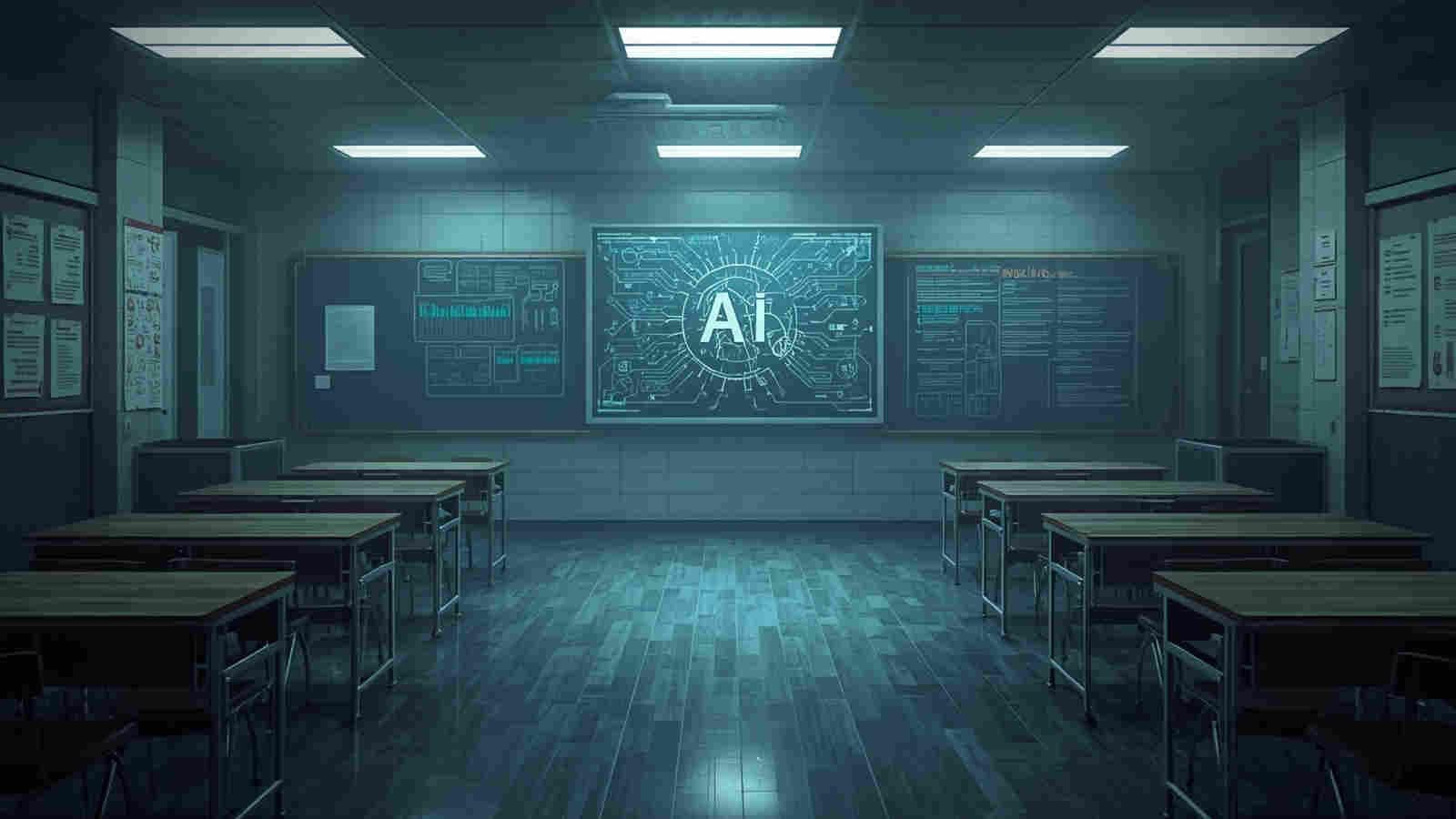
AI assists our team. It is not delivered to our students.
We may use AI internally to accelerate content production—writing, voice, graphics, and workflow—but every learner-facing output is human-vetted and approved before it reaches a headset.
That distinction matters.
The question is not whether AI is impressive. It is. The question is whether a school should place an unpredictable, data-hungry, cloud-dependent system directly between a learner and their education.
For us, the answer is: not until we can solve the responsibilities that come with it.
Agency belongs to the learner, not an algorithm.
— Sensible-VR core principle
1. Reliability: someone must own the answer
Generative AI can be remarkably helpful, but it can also produce false information, invented sources, poor advice, or confident answers that sound plausible because they are written fluently.
This is often called a hallucination. It is not a minor technical inconvenience when the audience is a student.
If an AI tutor tells a learner something incorrect, suggests an unsuitable course of action, or quietly misunderstands the question, who is responsible? The student should not be expected to know when a confident machine is wrong. The teacher should not be given another screen to monitor. And a school should not have to carry the burden of verifying every conversation after the fact.
The U.S. National Institute of Standards and Technology explicitly identifies AI “confabulation” or hallucination as a generative-AI risk. Stanford’s AI Index also notes that, despite rapid progress, consistent evaluation of factuality and safety remains limited across major model developers. NIST guidance Stanford AI Index
That does not mean AI has no place in education. It means that a responsible provider must be able to stand behind what reaches the learner.
At SVR, the learning content is designed, checked, and intentionally bounded. A module does not suddenly decide to teach something else, invent a source, or steer a child into an unreviewed conversation.
2. Privacy: student data is not a raw material
Children and schools deserve a higher standard than “click agree and hope for the best.”
Most cloud-based generative-AI systems require a user to send prompts, work, questions, and often contextual information to a provider. Depending on the service and its settings, that can create questions about retention, model improvement, account data, profiling, third-party processors, and where the data is stored.
UNESCO puts the issue plainly: use of generative AI almost always involves users sharing data with the provider. Its guidance calls for privacy protection, age-appropriate safeguards, and stronger governance in education. UNESCO guidance on generative AI in education
For a school, this is not merely a technical detail. A learner’s questions can reveal confusion, interests, abilities, anxieties, language level, learning needs, and personal circumstances. Those are not inputs to be casually placed into an unknown future data loop.
SVR’s platform is offline by design. We do not require a student account, a social-media account, constant internet access, or a cloud AI conversation for the learning experience to work.
That protects privacy, but it also protects dignity. Students should be able to explore, make mistakes, and learn without wondering who is collecting the trail.
3. Cost: “$20 per month” is not a long-term education strategy
A US$20 monthly AI subscription looks inexpensive. On paper, that is US$240 per person per year.
But the price on the screen is not the full economic story.
Large-language models require enormous and continuing investment in chips, data centres, electricity, networking, engineering, safety work, and model training. Those costs are not a one-time purchase; every substantial interaction requires computing power.
OpenAI has publicly said that its available computing capacity grew from about 0.2 GW in 2023 to about 1.9 GW in 2025, while annualized revenue reached more than US$20 billion. That is a useful reminder: the economics of AI are inseparable from massive infrastructure investment. OpenAI’s 2026 business update
There is no public, reliable figure for the true average cost of one AI user. Providers do not publish a clean “cost per student” number, and it would be misleading to pretend otherwise. Usage varies enormously: a learner asking a few short questions is not the same as a class using voice, image generation, long documents, agents, or real-time tutoring all day.
What we can say is simpler:
- US$20 per month is a retail price, not proof of a stable long-term cost.
- The underlying service has significant, recurring compute costs.
- A school that builds its learning model around a permanently connected, third-party AI service inherits pricing, access, and product-change risk.
- If the economics change, the burden eventually lands somewhere: with the provider, the school, the teacher, or the learner.
Education should not be built around an assumption that today’s subsidized price will always be tomorrow’s price.
4. Agency: learning is not the same as getting an answer
There is a fourth concern, and it may be the most important.
A learner needs to think, struggle productively, make judgments, test ideas, and own the result. AI can support that process—but it can also short-circuit it.
A fast answer can look like learning. It is not always learning.
The OECD warns that general-purpose generative AI can be useful when guided by sound teaching principles, but it is not a magic solution. It recommends tools designed with clear pedagogical intent, rigorous evaluation, and protection of teacher professional judgment rather than tools that replace cognitive effort. OECD Digital Education Outlook 2026
Sensible-VR is built around purposeful experience: observing, exploring, understanding, and reflecting. VR should deepen attention, not hand attention over to another system optimized to keep a conversation going.
The learner remains the active participant. The technology serves the learning.
AI has a role—but it must earn its place
We are not anti-AI. We are against passing unresolved problems down the chain to teachers, schools, and students.
If AI can be made reliable enough for the task, private enough for children, economically sensible for schools, and genuinely supportive of learner agency, then it may have a meaningful role within immersive education.
We are working on good AI ideas. But they will be introduced only when they meet the standards we believe schools deserve.
Until then, our position is straightforward:
Use AI to help people create better learning. Do not use students as the test case for problems you have not solved.
Agency belongs to the learner, not an algorithm.