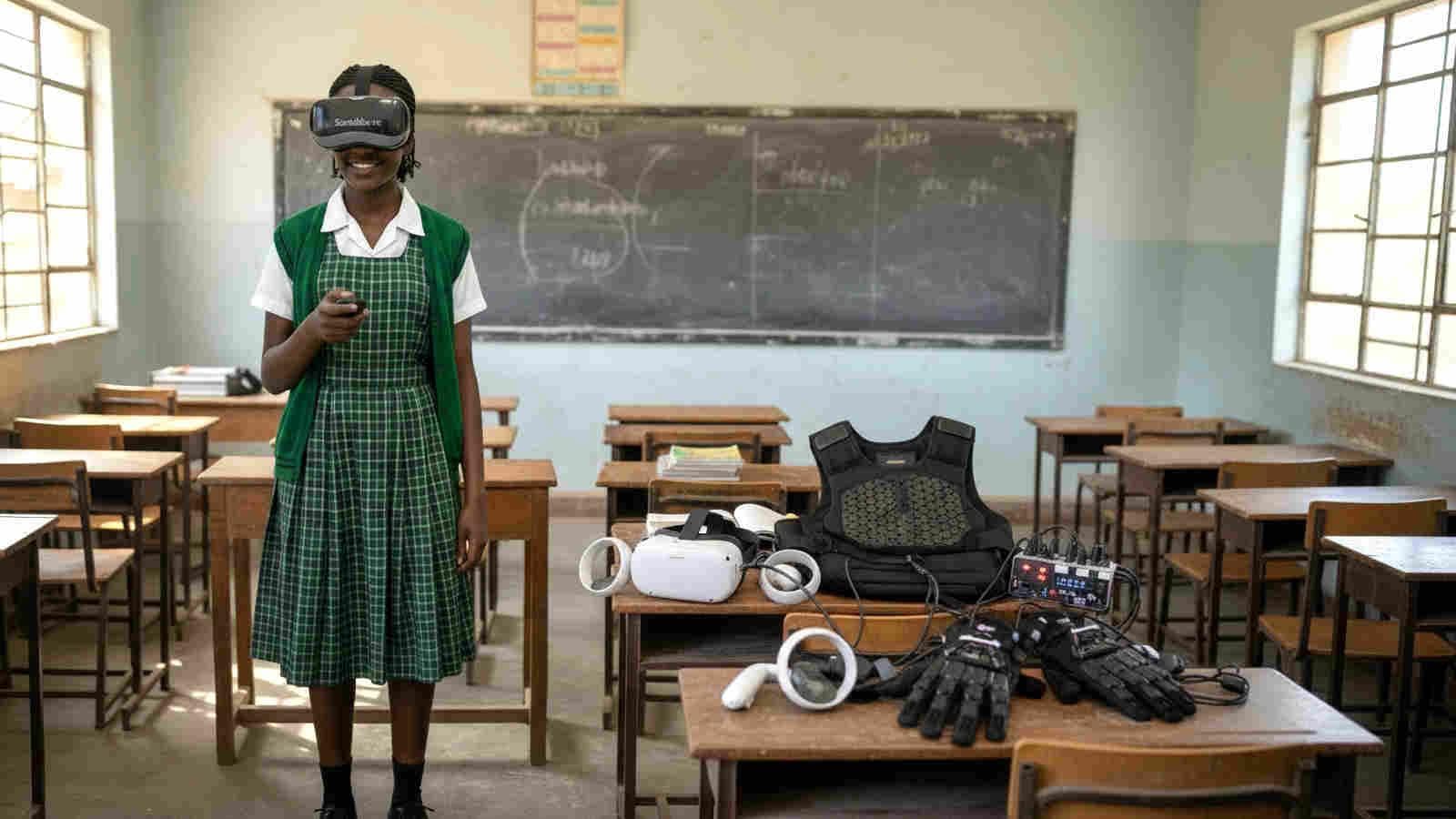
The next question may ultimately decide whether those benefits reach students at all:
Has the system been designed so that it can be used continuously and made readily available when the learner actually needs it?
Rizzo’s Virtual Classroom
Albert “Skip” Rizzo and his colleagues began exploring the relationship between VR and ADHD more than two decades ago. Their Virtual Classroom placed children inside a simulated learning environment where attention tasks could be presented with and without familiar classroom distractions.
A 2007 pilot study compared ten boys diagnosed with ADHD with ten boys in a control group. Children with ADHD made more omission and commission errors, moved more and were more affected by distractions. Measurements from the Virtual Classroom also correlated with established ADHD assessment tools.
This was a very small study, so its findings must be treated accordingly. It did not prove that VR could diagnose every child accurately, nor did it establish VR as a classroom treatment. What it demonstrated was important nonetheless: a controlled virtual environment could recreate meaningful classroom conditions while allowing researchers to examine how distraction affected attention and performance.
The technology helped make something difficult to observe more visible.
From Assessment to Intervention
Later research moved from assessment towards intervention.
A randomized clinical trial involving 51 children aged 7 to 11 compared virtual classroom cognitive remediation with methylphenidate and psychotherapy. The researchers found that the VR-based program reduced distractibility and concluded that it could represent an alternative in specific cases.
Again, this was not a large study, and it should never be interpreted as a general recommendation to replace medication or professional treatment with a headset. ADHD is complex, children differ enormously, and clinical decisions belong with families and qualified professionals.
Still, the findings showed that a virtual environment could do more than measure attention. Properly designed, it could potentially help learners practice it.
More recently, a 2026 randomized study involved 92 children aged 7 to 12 with ADHD. Half participated in an immersive VR program twice a week for eight weeks, while the other half formed a waiting-list control group.
The children who received the intervention showed substantial improvements in teacher-rated measures related to competence, symptoms, identity and their school environment.
That is genuinely encouraging. It suggests that VR may offer a valuable environment in which some neurodivergent learners can develop skills, confidence and stronger participation-related behaviours.
However, the details matter.
Effective in a Study, Available in a School?
The 2026 intervention was delivered in a university-based pediatric occupational therapy unit. Sessions were supervised and conducted in a standardized physical environment.
The researchers also reported device overheating, two session-ending shutdowns, temporary simulation sickness and the need for careful scheduling. They specifically acknowledged that repeated VR sessions may be difficult to integrate into ordinary schools without additional staff time, designated spaces and infrastructure.
This does not diminish the research. It reveals the next problem that must be solved.
A student does not only need access to VR during a carefully organized research trial. That student may need a calming, focused or supportive learning environment on an ordinary Tuesday morning, when the teacher has 29 other students, the IT specialist is elsewhere and no trained facilitator is standing beside the headset.
If accessing the intervention requires booking a special room, preparing tracking boundaries, checking an Internet connection, signing into accounts, updating software, monitoring movement and supervising every session, its availability will always be limited.
The learner may benefit from the experience, but the system may prevent the learner from reaching it.
Availability Is Part of Efficacy
This is where educational technology studies and real schools can drift apart.
Research often asks:
Can this intervention produce a measurable benefit under controlled conditions?
Schools must ask another question:
Can we deliver that benefit repeatedly, safely and affordably within the conditions we actually have?
Those are not competing questions. Both matter.
A learning tool that works beautifully twice a week with specialist supervision may still be valuable as a clinical intervention. But a classroom system must pass a different test. It must be simple enough to use frequently, by regular teachers, without requiring a specialist deployment every time.
For students with ADHD, timing may be particularly important. Support is most useful when it is available at the moment it is needed, not only when the room, technician and facilitator are available.
If VR is to support neurodivergent learners, readiness is not merely an operational convenience. Readiness is part of the intervention.
Designing for Continuous Use
A practical school system should therefore favour:
- Short, purposeful sessions
- Simple navigation
- Minimal setup
- Seated or stand-in-place use
- No unnecessary room-scale movement
- No dependence on continuous Internet access
- No student account required for routine learning
- Content already available on the device
- Minimal collection of student data
- Little or no need for teacher or IT intervention
None of these choices makes the learning less immersive. They make the learning more reachable.
There is also an important distinction between using behavioural data for a defined clinical assessment and collecting it routinely from every student. Rizzo’s work demonstrated that body movement could contribute useful information in a controlled ADHD study. That does not mean ordinary classroom learning systems should continuously collect, store or transmit behavioural biometrics.
A clinical measurement has a specific purpose, controlled conditions and professional oversight. General classroom surveillance does not inherit that justification automatically.
The Next Step
The research around ADHD and VR is promising, but the real opportunity lies in translating that promise into something schools can use without turning each session into a special event.
The goal should not be to create an impressive intervention that works only when everything is carefully arranged.
The goal should be to create a supportive learning environment that is waiting whenever the student needs it.
The news about VR and neurodivergent learners is good. Whether that good news reaches them will depend on the design.
Sources
- Parsons, T. D., Bowerly, T., Buckwalter, J. G., and Rizzo, A. A. (2007). A Controlled Clinical Comparison of Attention Performance in Children with ADHD in a Virtual Reality Classroom Compared to Standard Neuropsychological Methods. Child Neuropsychology, 13(4), 363–381.
- Bioulac, S., Micoulaud-Franchi, J. A., Maire, J., Bouvard, M. P., Rizzo, A. A., Sagaspe, P., and Philip, P. (2020). Virtual Remediation Versus Methylphenidate to Improve Distractibility in Children With ADHD: A Controlled Randomized Clinical Trial Study. Journal of Attention Disorders, 24(2), 326–335.
- Köse, B., Güler, E. C., Güney Yılmaz, G., Tanrıverdi, M., and Anaby, D. (2026). Exploring Immersive Virtual Reality as an Approach to Improve School Participation-Related Constructs in Children With ADHD. Child: Care, Health and Development, 52(5), e70328.