
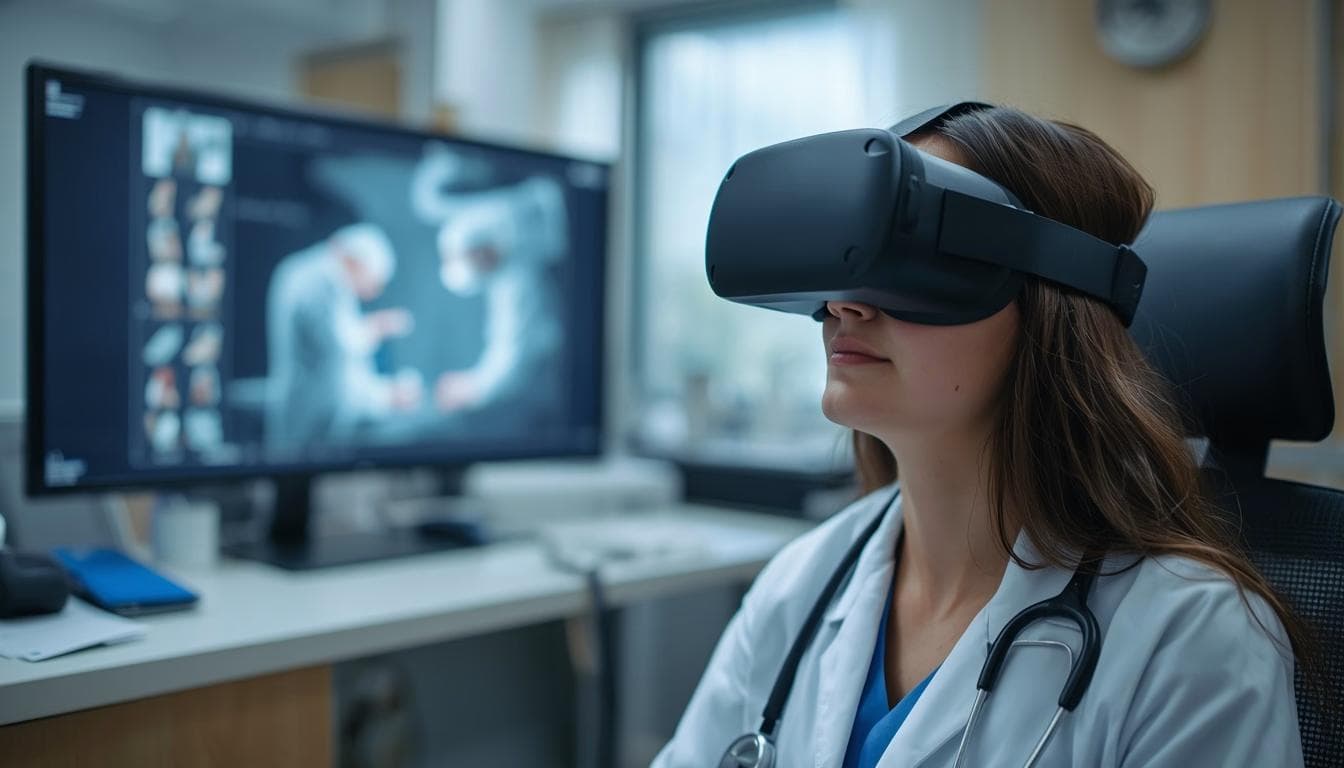
For a patient preparing for surgery, the operating room can represent a frightening unknown: unfamiliar equipment, strange sounds, medical staff moving through established routines and the uncertainty surrounding anesthesia. A conventional explanation can describe these things, but it cannot fully reproduce the feeling of being there.
Virtual reality can.
A peer-reviewed Canadian study published in the Journal of Surgical Oncology examined whether an interactive VR experience could help breast cancer patients prepare for surgery. The project brought together researchers from organizations including the University of Manitoba, CancerCare Manitoba and the National Research Council Canada.
The researchers were not using VR as entertainment or as a distraction. They used it to make an unfamiliar experience more understandable.
Entering the Operating Room Before Surgery
Participants in the VR group completed the experience one to two weeks before surgery. Inside the simulation, they explored a virtual operating room and experienced a representation of anesthesia induction.
This was more than simply watching a video. It was an immersive, first-person simulation intended to familiarize patients with the environment, equipment and sequence of events they would encounter.
Of the 27 people initially randomized, 23 completed the study: 12 in the VR group and 11 receiving standard care. Most participants—between 78.3% and 87%, depending on the measure used—reported elevated preoperative anxiety.
The response to the VR experience was encouraging:
- Participants rated it an average of 80.4% for helpfulness.
- Enjoyment averaged 87.7%.
- Every participant in the VR group considered the experience worthwhile.
- No adverse VR effects were reported.
The study also found preliminary trends toward lower postoperative anxiety and distress among the VR participants.
These trends matter, but they should not be overstated. This was a small feasibility study and was not designed with enough participants to prove that VR produced a statistically significant clinical improvement. One participant also reported increased anxiety, reminding us that an immersive experience must always be designed and introduced with care.
The appropriate conclusion is that the intervention was feasible, acceptable and promising enough to warrant a larger clinical trial.
VR Is Most Valuable When It Has a Clear Purpose
This study illustrates an important principle: VR does not have to transport someone to an impossible fantasy world to be valuable.
Sometimes its greatest contribution is allowing someone to experience an ordinary but unfamiliar place before it matters.
A physical operating-room tour would be difficult to arrange for every patient. It would require access to a highly controlled environment, coordination with hospital staff and additional time from already limited healthcare resources. A virtual experience can reproduce the essential preparation without requiring repeated physical tours.
The same principle applies in education.
Students can enter a laboratory before conducting an experiment, visit a workplace before beginning vocational training or rehearse a challenging social situation before facing it in real life. A learner can become familiar with unfamiliar equipment, environments and processes without disrupting the real setting or placing anyone at risk.
This is not VR for the sake of VR. It is purposeful preparation.
Familiarity Can Return a Sense of Control
The researchers identified several themes in participants’ feedback, including preparation for the operating room, emotional impact, realism, interactivity and the ability to support others.
At the centre of these themes is something very human: familiarity.
When people understand what they are likely to see and what may happen next, the unknown becomes more manageable. VR cannot remove the seriousness of surgery, but it may help replace some uncertainty with knowledge and preparation.
That is also one of immersive learning’s greatest strengths. Reading and watching remain valuable, but there are occasions when a person benefits from being placed inside the situation. The environment becomes spatially understandable. The sequence becomes clearer. The learner can focus on what matters before confronting the real experience.
The Lesson Is Not “More Technology”
The study used a laptop-connected Oculus Rift S, handheld controllers and a clinician interface that allowed personnel to monitor and assist participants. This was appropriate for an early clinical prototype, but the research should not be interpreted as an endorsement of any particular headset or deployment model.
The broader lesson is more important: technology should be selected according to the outcome it needs to achieve.
Not every experience requires room-scale movement, extensive tracking or complicated interaction. In many familiarization and preparation applications, the essential objective is to let the user look around, understand the environment and follow a carefully structured experience.
Complexity should earn its place.
For VR to move beyond controlled trials and specialized demonstrations, it must also become practical. It must be easy to deliver, repeatable, accessible to the intended users and sustainable for the organization providing it. A promising experience that requires excessive staffing, technical support or infrastructure will struggle to reach the people who could benefit from it.
From Novelty to Useful Infrastructure
This Canadian study does not provide the final word on VR and surgical anxiety. Its sample was small, and larger trials are needed to determine the intervention’s clinical effectiveness.
What it does provide is a valuable and responsible step forward.
The experience was completed successfully during the period between surgical consultation and surgery. Participants generally found it helpful and worthwhile. No adverse VR effects were reported, and the researchers concluded that the intervention could potentially be integrated into pre-anesthesia appointments or even delivered in a patient’s home. Its underlying approach may also be applicable to surgeries beyond breast cancer.
That is how useful technology develops: not through exaggerated promises, but through carefully defined problems, appropriate experiences and honest evaluation.
At Sensible-VR, we believe immersive technology should be judged by what it helps people understand—not by how technically impressive it appears.
Whether the setting is an operating room, a laboratory, a workplace or a classroom, the principle remains the same:
When uncertainty creates fear, experience can create understanding.
Source
El-Gabalawy, R., Logan, G. S., Hebbard, P., Sommer, J. L., Reynolds, K., Penner, K. E., Smith, M. S. D., Mota, N., Mutch, W. A. C., Mollanji, E., Maples-Keller, J. L., Perrin, D., & Arora, R. C. (2026). An interactive preoperative virtual reality intervention for breast cancer patients undergoing oncological surgery: A feasibility and pilot randomized clinical trial. Journal of Surgical Oncology, 134(1), 5–15. https://doi.org/10.1002/jso.70269
The study is also available through the National Research Council Canada Publications Archive.