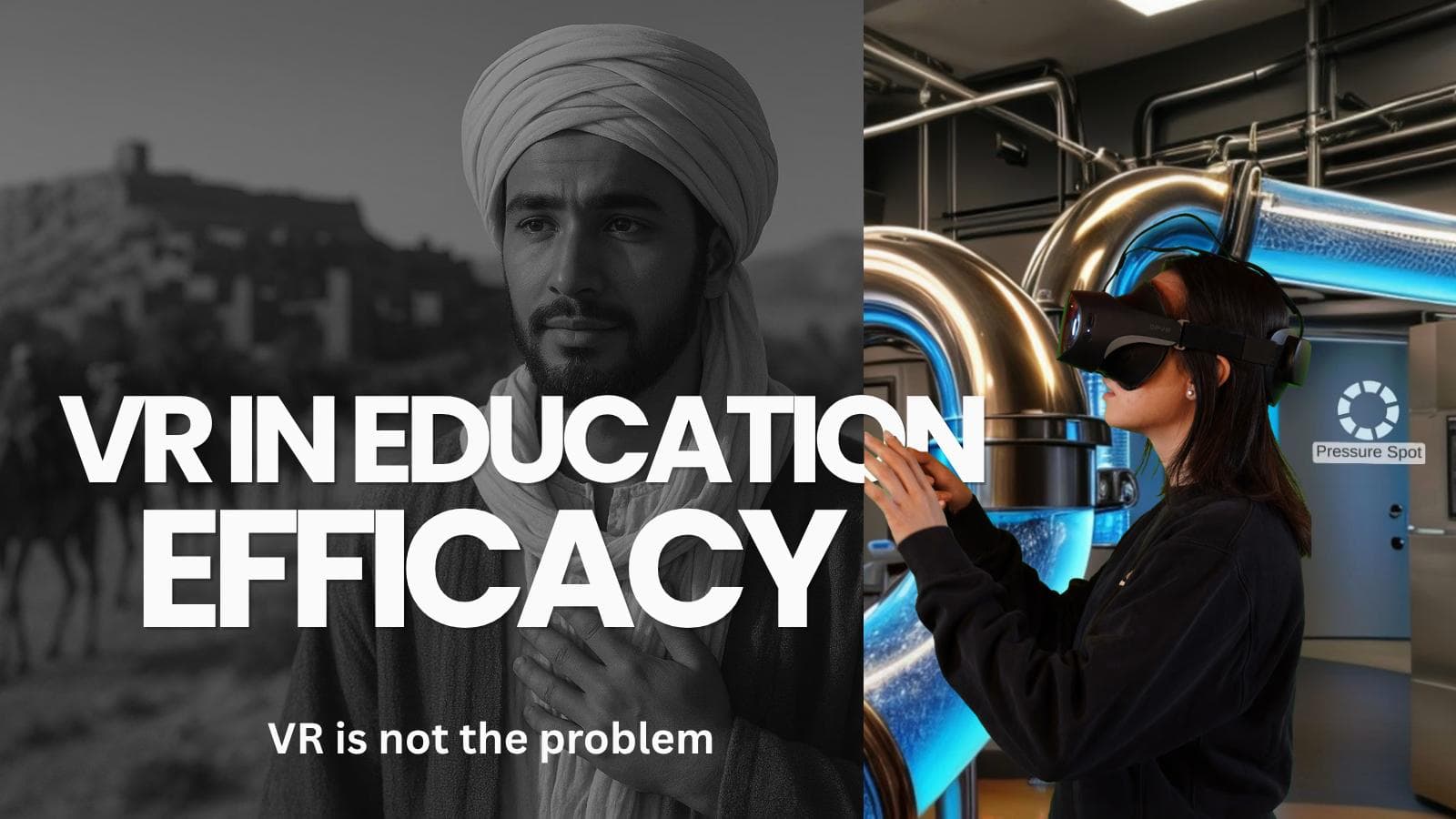
Research also shows promise for engagement, confidence, procedural learning and perspective-taking.
That is not magic. It is understandable.
When a learner is placed inside a meaningful context, can focus on one task, and is able to practise without the social cost of getting an answer wrong in front of classmates, VR can create conditions that ordinary media often cannot. It can support attention, spatial understanding, experiential learning, confidence, recall, skill rehearsal, empathy, awareness and engagement.
But there is an important caveat: presence is not pedagogy. Poorly designed immersive experiences can overload learners, heighten irrelevant emotional arousal, and reduce transfer of learning. The lesson is not that VR has failed. The lesson is that educational VR must be designed to help the learner focus—not merely to impress them.
So, what is the real problem?
The Problem is not VR
It is the tendency to mistake a pile of consumer technology for an educational solution.
Too many schools are being offered a consumer gaming headset, an internet-dependent platform, a management layer, a collection of apps and a long list of “justs”:
- Just connect it to Wi-Fi.
- Just create accounts.
- Just configure the firewall.
- Just buy the MDM.
- Just train teachers.
- Just supervise every session.
- Just keep repairing the system when the consumer product cycle moves on, and desperately try to keep the system going.
That is not a solution. It is a burden transfer.
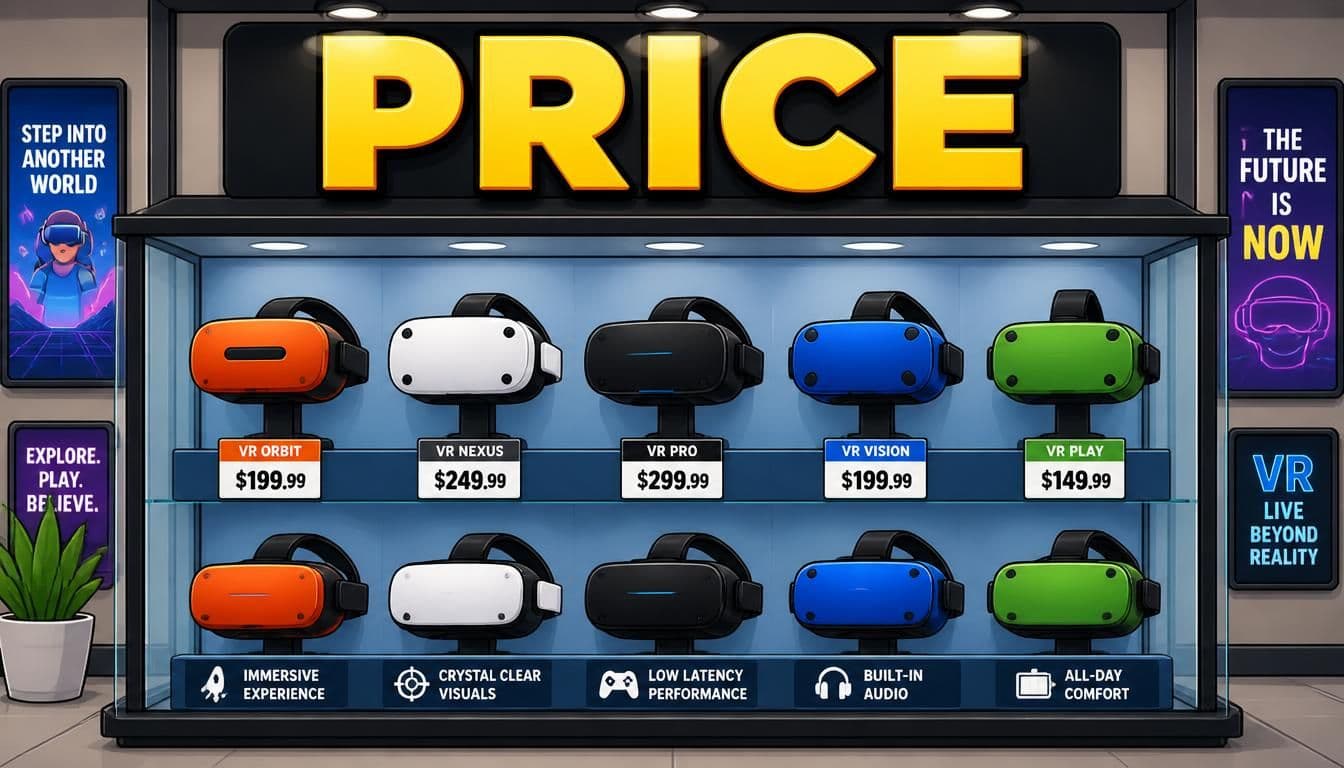
The provider gets to quote a low headset price. The school inherits the real work: device administration, content deployment, account management, updates, network demands, teacher training, safeguarding, supervision, troubleshooting, replacement planning and the cost of keeping an ageing consumer product alive.
A headset price is not a total cost of ownership.
A VR system that requires a facilitator every time it is used has quietly made that facilitator part of the purchase price. A system that requires an MDM merely to put the right learning content on the right devices has added another layer of cost and complexity before a student has learned anything. A “cheap” device that becomes difficult to support in year three, four or five is not inexpensive; it is simply expensive later.
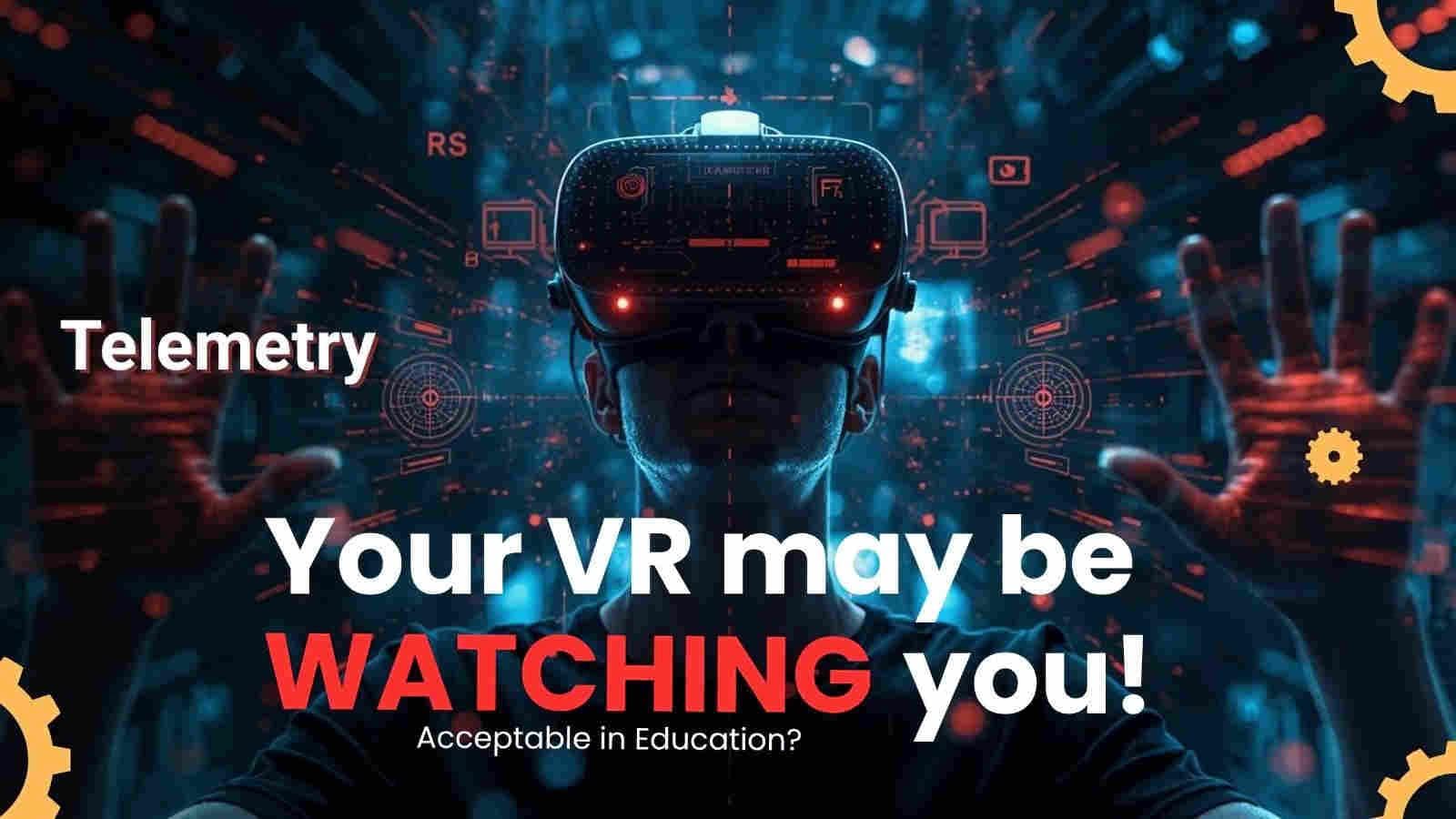
There are deeper issues, too. Motion-tracked VR data should not be treated as harmless. Research has shown that ordinary VR movement data can identify individuals with striking accuracy. Schools should therefore ask a basic question:
Why should a child’s movement, gaze, hands, physical habits and learning activity be gathered by a consumer ecosystem when none of that is necessary for the lesson?
Likewise, unnecessary physical movement is not a mark of educational quality. Collisions and falls are real VR risks. Movement has a place when the learning objective truly requires it. It should not be the default architecture for a classroom.
This is why the debate should not be framed as “3 DoF versus 6 DoF.”
It is about choosing the right tool for the learning task.
For the great majority of school learning, a learner does not need to walk around a room waving their arms. They need to look, listen, think, speak, observe, explore, answer, repeat and reflect. A practical 3 DoF mode supports that exceptionally well: seated or standing in place, focused, simple to deploy, manageable in ordinary classrooms, and suitable for learners who may find movement-heavy systems difficult or unsafe.
For the smaller category of learning where hand interaction genuinely matters—fine-motor practice, specialist simulation, manipulation or creation—then hand tracking can be enabled. That is a sensible design principle:
Use immersion where it helps. Use interaction where it is necessary. Do not impose either where it adds burden without learning value.
SVR’s position should therefore be clear:
We are not defending 3 DoF because it is fashionable. We are defending practicality because schools need systems that endure.
The goal is not to win an argument about specifications. The goal is to make VR as ordinary and dependable as a calculator: pick it up when it is useful, learn what you need to learn, put it down, and carry on.
That future will not be built by forcing schools to adapt to consumer gaming products. It will be built by designing educational technology that makes sense technically, pedagogically, economically and ethically.
VR succeeds when it stops being a special event—and becomes useful infrastructure.
Sources
Coban, M., Bolat, Y. I., & Göksu, I. (2022). The potential of immersive virtual reality to enhance learning: A meta-analysis. Educational Research Review, 36, 100452.
Kyaw, B. M., et al. (2019). Virtual reality for health professions education: Systematic review and meta-analysis. Journal of Medical Internet Research, 21(1), e12959.
Liu, J. Y. W., et al. (2024). The effects of immersive virtual reality–assisted experiential learning on knowledge and empathy. JMIR Medical Education, 10, e48566.
Parong, J., & Mayer, R. E. (2020). Cognitive and affective processes for learning science in immersive virtual reality. Journal of Computer Assisted Learning, 37(1), 226–241.
Miller, M. R., et al. (2020). Personal identifiability of user tracking data during observation of 360-degree VR video. Scientific Reports, 10, 17404.
Nair, V., et al. (2023). Unique identification of 50,000+ virtual reality users from head and hand motion data. USENIX Security Symposium.
Cucher, D. J., et al. (2023). Virtual reality consumer product injuries: An analysis of national emergency department data. Injury Epidemiology, 10, 5.