
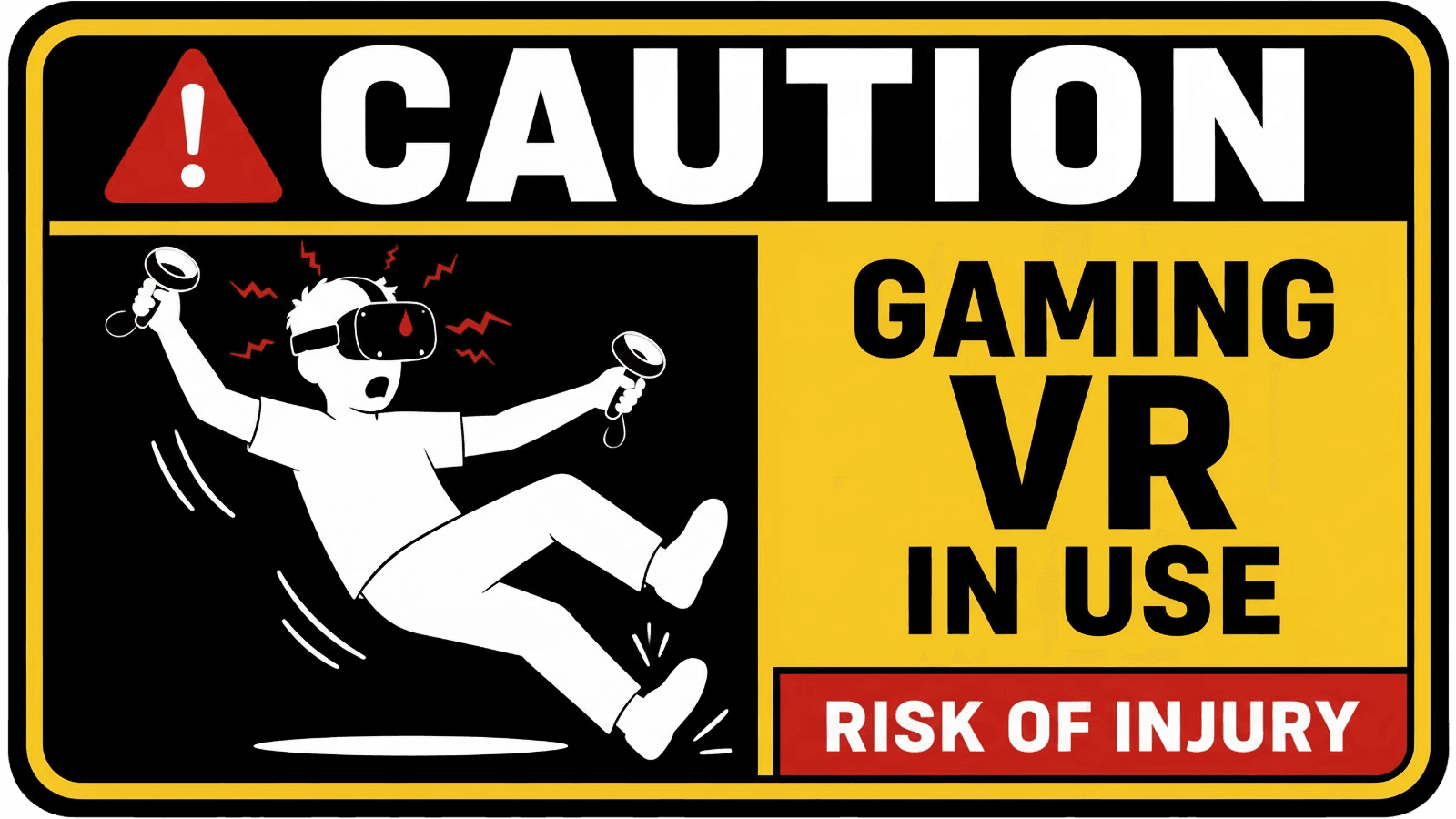
What are the costs and risks created by the way the technology is designed to be used?
This is particularly important when comparing 6 DoF, room-scale VR with a more stationary 3 DoF approach.
This is not an argument that 6 DoF VR is inherently unsafe. Nor is 3 DoF completely without risk. Any technology used by people can introduce hazards. Even a calculator can distract someone from an object falling from a shelf.
The difference is the physical hazard envelope created by the technology.
6 DoF changes the physical environment
A 3 DoF headset primarily responds to the user's head orientation: looking left and right, up and down, and tilting the head. It is immersive.
A 6 DoF system adds positional movement to that immersion. The system tracks where the user is in physical space, allowing the user to walk, reach, dodge, turn and interact with a virtual environment through physical movement.
This is one of the great strengths of modern VR gaming. It is also one of its additional risks.
Meta's own current documentation makes the distinction very clear. Its Stationary mode is designed for a small space of approximately 1 × 1 metre, while Roomscale is specifically designed for users to move around inside a physical play area. Meta recommends approximately 2 × 2 metres of unobstructed space for Roomscale use.
The reason for the boundary system is equally clear. Meta explains that immersive applications track and translate a user's real-world movement into the virtual world, and that its Boundary system provides warnings when the user's head or controllers approach the edge of the defined play area.
In other words, the physical environment is not incidental to Roomscale VR.
It is part of the system that has to be managed.
These injuries are not hypothetical
There is now published evidence that VR-related injuries occur.
A peer-reviewed study published in Injury examined the U.S. Consumer Product Safety Commission's National Electronic Injury Surveillance System (NEISS), using emergency-department records from 2013 through 2021.
The study estimated 1,336 VR-related emergency-department visits in the United States in 2021. That represented a 352% increase compared with the beginning of the period studied.
The types of injuries are also significant:
- 30.3% were fractures
- 18.6% were lacerations
- 13.9% were contusions
- 10.0% were strains or sprains
For users aged 6–18, the most common injury locations included the hand (22.3%) and face (12.8%).
These are not theoretical possibilities. They are injuries that resulted in people appearing in emergency departments and were sufficiently documented to enter the national injury surveillance system.
But there is an important qualification
1,336 is not the number of all VR injuries.
It is an estimate of emergency-department visits captured by NEISS.
Many injuries never result in an ER visit. A person may treat a minor injury themselves, visit a family doctor or urgent-care facility, report an incident to an organization without seeking medical treatment, or simply continue on without reporting it at all.
Therefore, the published figure should be understood as a lower-bound indicator of the problem, not a census of all injuries.
The researchers themselves describe the data as emergency-department records and note that the medical literature contains only a limited number of reported VR injuries.
This distinction is important.
Reported injuries are not the same thing as total injuries.
And these numbers are already old
There is another reason to be cautious about interpreting 1,336 as today's number.
The study's data end in 2021.
That was a very different VR market from today's market.
The researchers noted that consumer VR sales increased dramatically during the period they studied. They reported more than 10 million consumer units sold in 2021 and anticipated continued growth in consumer and commercial VR.
The study therefore gives us an important historical signal:
As VR adoption increased, recorded VR-related injuries increased substantially.
It does not tell us the exact number of injuries occurring in 2026.
And it certainly should not be used to claim that there are exactly 1,336 VR injuries per year today.
The responsible conclusion is simpler:
There is documented evidence of VR-related injury, the recorded number was increasing with adoption, and the published national data are several years behind the current VR market.
That is enough to require consideration when an organization is planning a large-scale deployment.
Property damage is also a documented cost
Injury isn't the only issue.
VR can also damage the physical environment around the user.
This is not merely something seen in internet videos. It has appeared in insurance claims.
UK insurer Aviva reported a 31% increase in home-content insurance claims involving VR headsets in 2021, with claims 68% higher than in 2016. The average VR-related accidental-damage claim in 2021 was approximately £650. Broken televisions were among the commonly reported losses.
Reported incidents included controllers striking televisions, people colliding with furniture and other objects being damaged during VR play.
Again, this is not a claim that £650 is the average cost of VR property damage everywhere in the world. It is UK insurance data from one insurer.
But it establishes something important:
Property damage from VR is a real, recurring insurance phenomenon.
The "VR fail" videos are not statistical evidence—but they demonstrate the mechanism
Anyone who has spent time around VR has probably seen them.
The videos are everywhere:
- someone punches a television;
- someone swings a controller into a wall;
- someone falls into furniture;
- someone kicks an object;
- someone crashes into another person;
- someone backs into something they cannot see;
- someone loses their balance while completely immersed.
These videos should not be used to calculate an injury rate. They are inherently biased because spectacular accidents are much more likely to be recorded and shared.
But they do demonstrate the mechanism.
The user is immersed in a virtual environment while their awareness of the physical environment is reduced. If the experience encourages physical movement, there is an obvious opportunity for that movement to interact with the real world.
Even Meta's current developer safety guidance explicitly warns developers about experiences that require users to back up quickly, dodge, run or flee, stating that these activities increase the possibility of unintended trips, contact or breakage.
That is a useful observation because it comes from the manufacturer of one of the world's largest VR platforms.
The safety infrastructure itself tells us something
A modern 6 DoF system needs additional safety infrastructure precisely because the user can move through physical space.
Meta's Boundary system requires users to establish an unobstructed activity area and provides visual warnings when they approach its limits. Passthrough can be activated to help users see physical objects outside the play area.
If there is a suggestion that passthrough is a remedy to this problem, it does so with a significant cost… distraction. This puts solutions touting 6 DoF in an unenviable position: drop of the distraction-free claim to solve part of the safety issue, or promote distraction-free and accept the liability.
This isn't a criticism of the Boundary system. It is good engineering. But it is a design choice made for gaming and entertainment, and very specific learning (welding, surgery, jewelry-making) which is 1% of what can be learned in VR.
But it demonstrates the underlying issue:
Once physical movement becomes part of the VR experience, managing the physical environment becomes part of deploying the technology.
That has consequences for schools and organizations.
The real cost isn't just the headset
Imagine a school purchasing four VR headsets.
The obvious calculation might be:
4 headsets × hardware price + software = total cost.
But that completely dismisses the actual cost of deployment. Depending on the technology and the applications being used, an organization may also need to consider:
- adequate physical space;
- clearing furniture and obstacles;
- appropriate flooring;
- separation between users;
- supervision;
- classroom management;
- staff training;
- safeguarding procedures;
- replacement of damaged equipment;
- damage to furniture and displays;
- potential injuries;
- insurance;
- incident reporting;
- duty-of-care considerations;
- and the operational time required to manage the system.
These are legitimate costs of doing business. They don't necessarily make 6 DoF a bad choice. They mean that the purchase price of the headset is not necessarily the total cost of ownership.
Proper supervision will mitigate the risks. However, admin needs to pay for that supervision. A facilitator costs money. You must factor that cost into your solution.
“A teacher or trainer is already there and being paid” is an argument made by those who have not worked in training or teaching in a serious way. For an instructor to have to dedicate their time and efforts to VR supervision means that they are taken away from the other 8 people being trained, or the other 28 students in the class.
3-DoF does not mean "zero risk"
This distinction is important. Sensible-VR does not argue that 3-DoF is completely risk-free.
- A student can become distracted.
- A student can become dizzy.
- Someone can walk into a student.
- A piece of equipment can fall.
- A student can trip over a chair.
There are countless ordinary risks in any classroom. The argument is not that 3-DoF eliminates risk.
The argument is that a stationary 3-DoF educational experience does not deliberately add the same requirement for physical movement through the environment.
Meta itself describes its stationary experience as a compact alternative that does not promote much movement beyond reaching or leaning, whereas Roomscale is specifically intended for moving around.
That is a meaningful difference.
Different technology choices create different risk profiles
This is ultimately a question of judgement.
If a school chooses 6 DoF VR because physical interaction and movement are essential to the learning objective, then those benefits may justify the additional infrastructure and risk-management requirements.
For example, there are legitimate applications where precise physical movement is central to the activity, such as welding, surgery, and jewelry-making.
But if the educational objective is to:
- explore another country;
- do a chemistry experiment;
- grab and rotate a 3D object, like the heart;
- open a bank account;
- virtually walk around an historical site;
- learn about car manufacturing production lines;
- experience the savannah in Africa;
- observe a scientific phenomenon;
- make meaningful safety choices;
- speak with a language instructor;
- and answer assessment questions along the way,
then the organization should ask a simple question:
Is physical movement actually necessary to achieve the educational objective?
If the answer is no, there is a reasonable argument for choosing a system that does not introduce additional physical-movement requirements merely because the technology makes them possible.
Infrastructure requires a different way of thinking
This becomes increasingly important as VR moves from novelty to infrastructure.
A school or company cannot reasonably say:
"We bought four headsets, therefore we have implemented VR."
The real question is:
What does it cost to operate this technology safely and effectively over five or more years?
If an organization chooses a technology that encourages physical movement while the user's normal view of the environment is obscured, then injury, property damage, supervision and insurance considerations are part of the deployment equation.
They should not be treated as unexpected exceptions.
They are part of the cost of doing business associated with that design choice.
The sensible approach
The objective should not be to eliminate every possible risk. That is impossible.
The objective should be to avoid introducing unnecessary risks when they do not contribute meaningfully to the desired outcome.
This is the philosophy behind Sensible-VR.
3-DoF is not claimed to be risk-free. It is simply a different engineering choice.
A stationary educational VR system can provide deep immersion without requiring users to walk around a room, dodge virtual objects, swing controllers or establish a room-scale play area.
For many educational applications, that may be enough.
And if it is enough, there is a reasonable question to ask:
Why introduce the additional physical exposure at all?
That is not an argument against VR.
It is an argument for choosing the amount of technology that is actually necessary for the job.
Purposeful immersion should be deep enough to improve learning, but simple enough to actually be used.
That is what we mean by Sensible-VR.

