
(Translated to English, from original Japanese text)
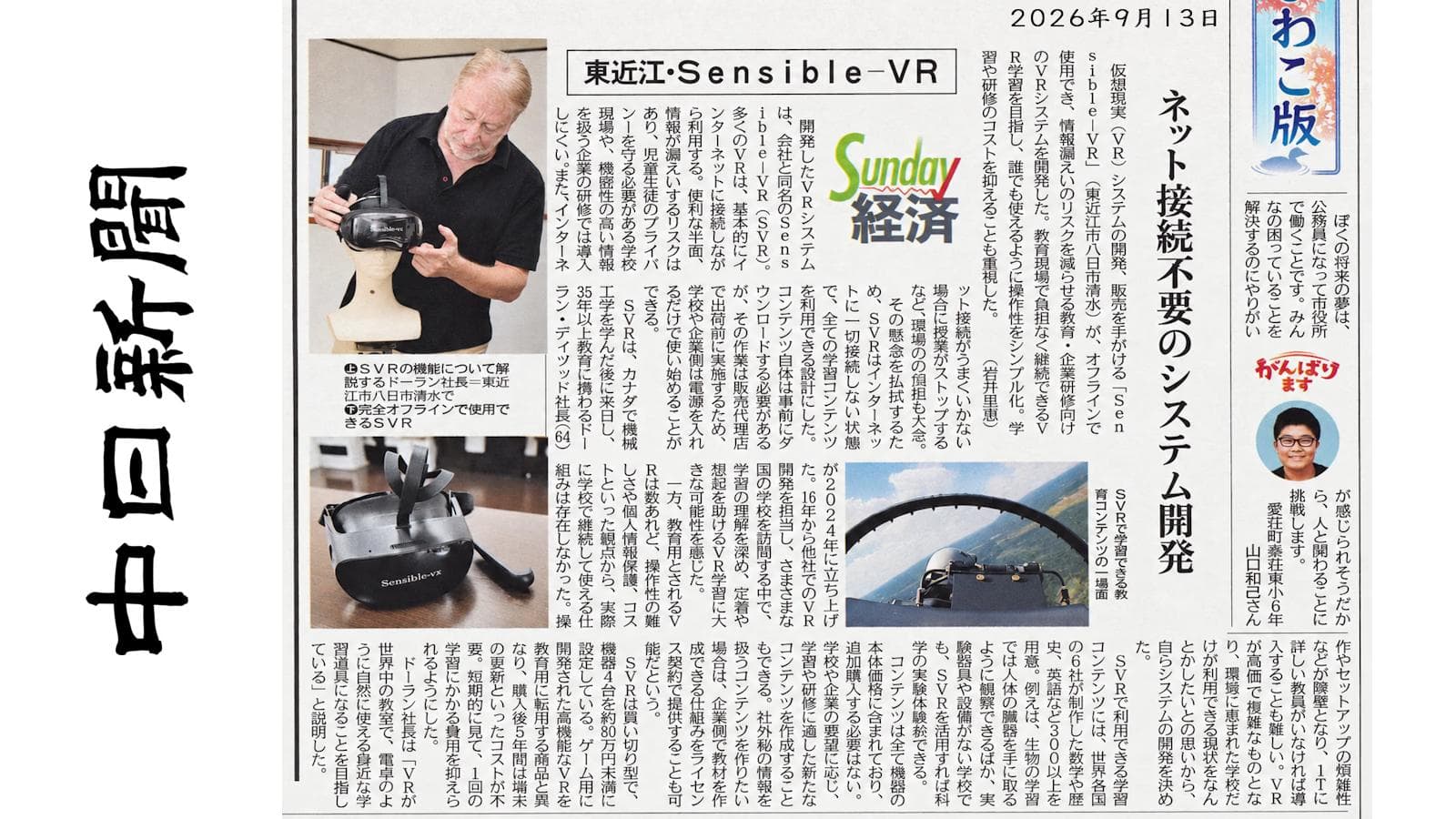
Sensible-VR, a company based in Yokaichi Shimizu, Higashiomi, that develops and sells virtual reality systems, has developed a VR system for education and corporate training that can be used offline, reducing the risk of information leaks.
Aiming to make VR learning sustainable in educational settings without placing an additional burden on schools, the company has simplified the system so that anyone can operate it. It has also placed importance on keeping the costs of learning and training down.
The VR system is called Sensible-VR, or SVR—the same name as the company. Most VR systems are normally used while connected to the internet. Although this is convenient, it creates a risk of information leakage.
This can make such systems difficult to introduce in schools, where students’ privacy must be protected, and in corporate training environments that handle highly confidential information. There are also operational problems: if the internet connection does not work properly, for example, a lesson may come to a stop.
To eliminate these concerns, SVR was designed so that all learning content can be used without connecting to the internet at all.
The content must be preloaded in advance, but this is handled by the manufacturer, before the equipment is shipped. Schools and companies can therefore begin using the system simply by turning it on.
SVR was established in 2024 by its president, David Dolan, 64. After studying mechanical engineering in Canada, Dolan came to Japan and has been involved in education for more than 35 years.
Beginning in 2016, he worked on VR development at another company. As he visited schools in various countries, he came to see great potential in VR learning to deepen understanding and help students retain and recall what they have learned.
Although many VR products are described as being designed for education, Dolan found that no system existed that schools could continue using in practice when ease of operation, personal-information protection and cost were all taken into consideration.
SVR provides more than 300 learning experiences for subjects such as STEM*, financial literacy*, English and other subjects, created by six companies from around the world.
In biology, for example, students can examine the organs of the human body as though they were holding them in their hands. Schools without laboratory equipment or facilities can also use SVR to experience scientific experiments.
All of the content is included in the price of the equipment, so no additional purchases are necessary.
SVR can also create new content suited to learning or training in response to the needs of schools and companies. If a company wants to create content involving confidential information, SVR can provide, through a licensing agreement, a system that allows the company to produce the training materials itself.
SVR is sold through a one-time-purchase model, with four devices priced at under approximately ¥800,000.
Unlike products that repurpose high-performance VR equipment originally developed for gaming, SVR does not require costs such as replacing or updating the devices during the first five years after purchase. The system was designed to reduce the cost of each learning session over the long term.
“Our aim is for VR to become a familiar learning tool in classrooms around the world—something used as naturally as a calculator,” Dolan said.
Photo captions
Top: SVR President David Dolan explains the system’s functions in Yokaichi Shimizu, Higashiomi.
Bottom: The SVR system can be used completely offline.
Right: A scene from educational content (F-16 fighter jet) available through SVR.
*Small editorial change from Japanese original, for clarity and accuracy