
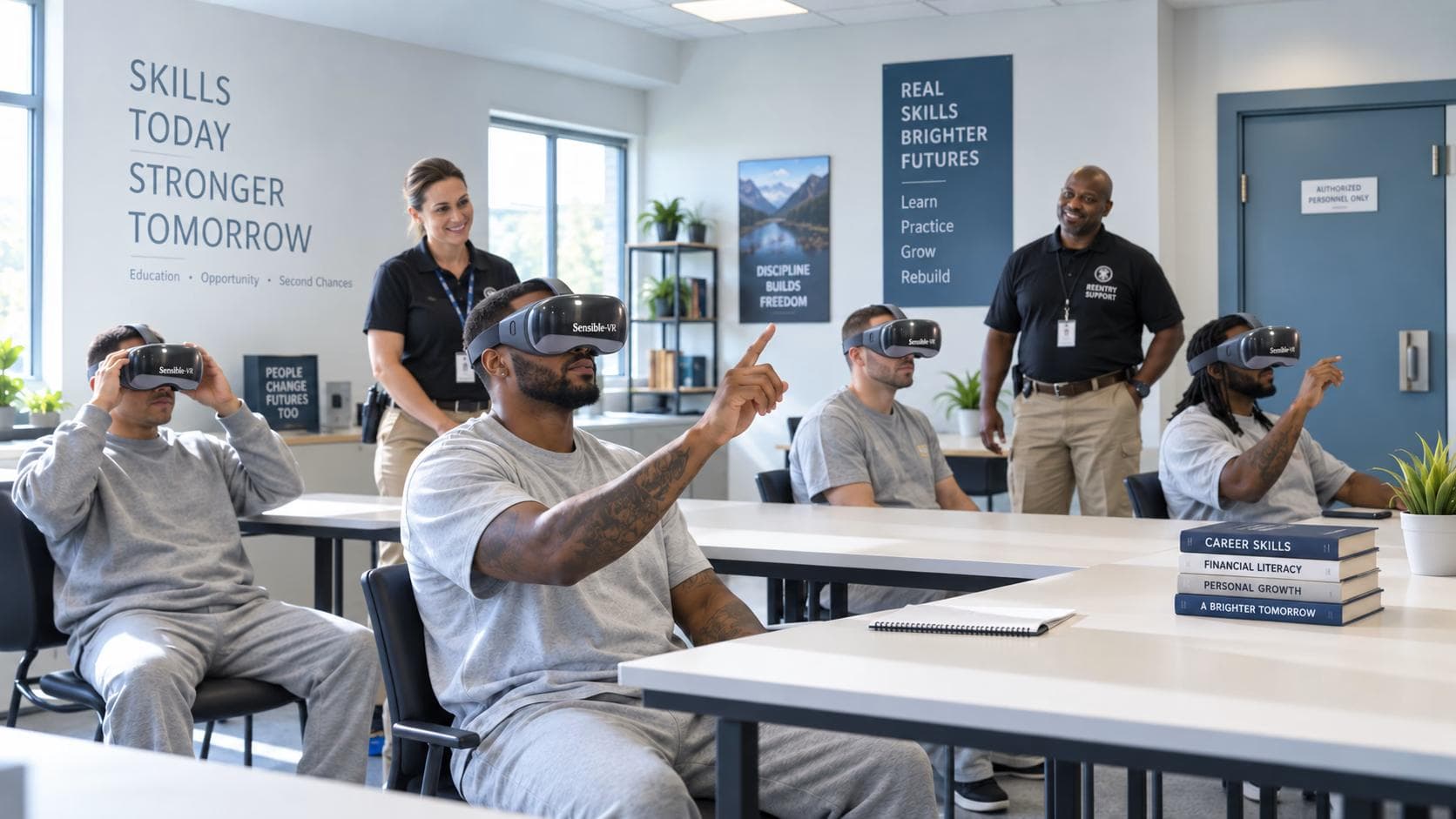
I have been connected with the University of the Philippines Open University (UPOU) for several years, and have had the privilege of participating as a featured speaker in its conferences and discussions around virtual reality and immersive learning.
What I have always appreciated about UPOU is that the conversation is rarely about technology for technology's sake. It is about access. Who can we reach? What barriers can we remove? How can technology make meaningful education available where conventional approaches struggle?
That thinking has brought us to an area I believe deserves much more attention: immersive learning in correctional education.
UPOU is already doing important work here. Through its partnership with the Philippine Bureau of Corrections (BuCor), it has been providing educational opportunities to Persons Deprived of Liberty. On August 14, 2026, the Philippine News Agency reported that 144 PDLs had completed courses through the BuCor-UPOU Development Professional Growth Program. Courses included functional English, business and entrepreneurship, permaculture, and programming.
That matters.
Education in a correctional environment is not simply about filling time. It can be about maintaining a connection with society, developing skills, creating confidence, preparing for employment and ultimately helping someone prepare for life beyond incarceration.
But correctional education presents an obvious technology problem.
What happens when the internet is not the answer?
Most modern digital-learning systems assume connectivity.
They assume cloud services, user accounts, regular software updates, streaming media, remote servers and, increasingly, continuous collection of user data.
Inside a correctional institution, many of those assumptions become problems rather than benefits.
UPOU has already recognized this. Its correctional learning includes Small Private Offline Courses, allowing structured digital education to be delivered without depending on conventional internet access.
This is where our work at Sensible-VR becomes particularly relevant.
We built Sensible-VR as an education system first. It can operate completely offline. It does not require a social-media account or connection to a social-media ecosystem. We do not need to know where the learner is looking, how their body moves, what their room looks like or how they behave from one session to the next. By default, we simply do not need to track the learner.
In schools, we see these as sensible design choices.
In corrections, they may be fundamental requirements.
VR can provide something different
There is another reason I believe immersive learning deserves serious examination in corrections.
A person in a correctional facility cannot simply go somewhere to learn.
- They cannot visit a factory to understand a workplace.
- They cannot walk around a university campus.
- They cannot tour a hotel, laboratory, construction site or manufacturing facility.
- They may have limited opportunities to practice situations they will encounter after release.
They cannot readily travel to another country, stand inside an important historical location, explore an ecosystem, or experience many of the places the rest of us take for granted as part of learning about the world.
VR can bring those places to them.
And it does not necessarily require complicated simulations, expensive gaming systems or elaborate motion tracking to do it.
Sometimes the educational value is simply being there: looking around, listening, understanding a place, receiving information in context, making a few meaningful decisions and reflecting on what has been learned.
This is exactly the kind of purposeful immersive learning we have been advocating for years.
Starting with learning, not VR
UPOU itself has become an important centre for this kind of thinking. Its immersive-learning initiatives are focused not simply on adopting XR technology, but on developing sustainable, accessible and responsible approaches to immersive education. At the World Immersive Learning Labs Symposium hosted by UPOU in March 2026, discussions included ethical considerations, scalable immersive-learning models, learning assessment and the responsible use of emerging technologies. Sensible-VR was pleased to be part of that environment.
We are now beginning to explore how some of these ideas can be applied to correctional learning.
It is early, and that is important to say.
The objective is not to arrive with a collection of headsets and announce that VR is the solution.
It is to work with educators, learners and people who understand corrections and ask better questions:
- Where does immersion genuinely improve learning?
- What experiences are currently unavailable to these learners?
- What skills and knowledge could better prepare someone for education, employment or reintegration?
Can we provide those experiences without introducing unnecessary connectivity, surveillance, complexity or staff burden?
If the answer is yes, then there is something worth pursuing.
Offline does not mean disconnected from the world
We have become accustomed to thinking that every new technology must be connected to everything, all the time.
I don't think that is true.
An offline device can contain an extraordinary amount of knowledge. It can take someone around the world. It can provide language learning, science, financial literacy, career exploration, workplace familiarization and experiences that would otherwise be completely inaccessible.
And it can do so without sending information about that learner somewhere else.
For some learning environments, that is convenient.
For others, including correctional education, it could be transformative.
There is a simple idea behind what we are beginning to explore with UPOU:
When the learner cannot go to the world, bring the world to the learner.
That, to me, is one of the strongest arguments for virtual reality in education.