It usually begins with a teacher, administrator, researcher, or educational technology consultant telling me about a young person they know.
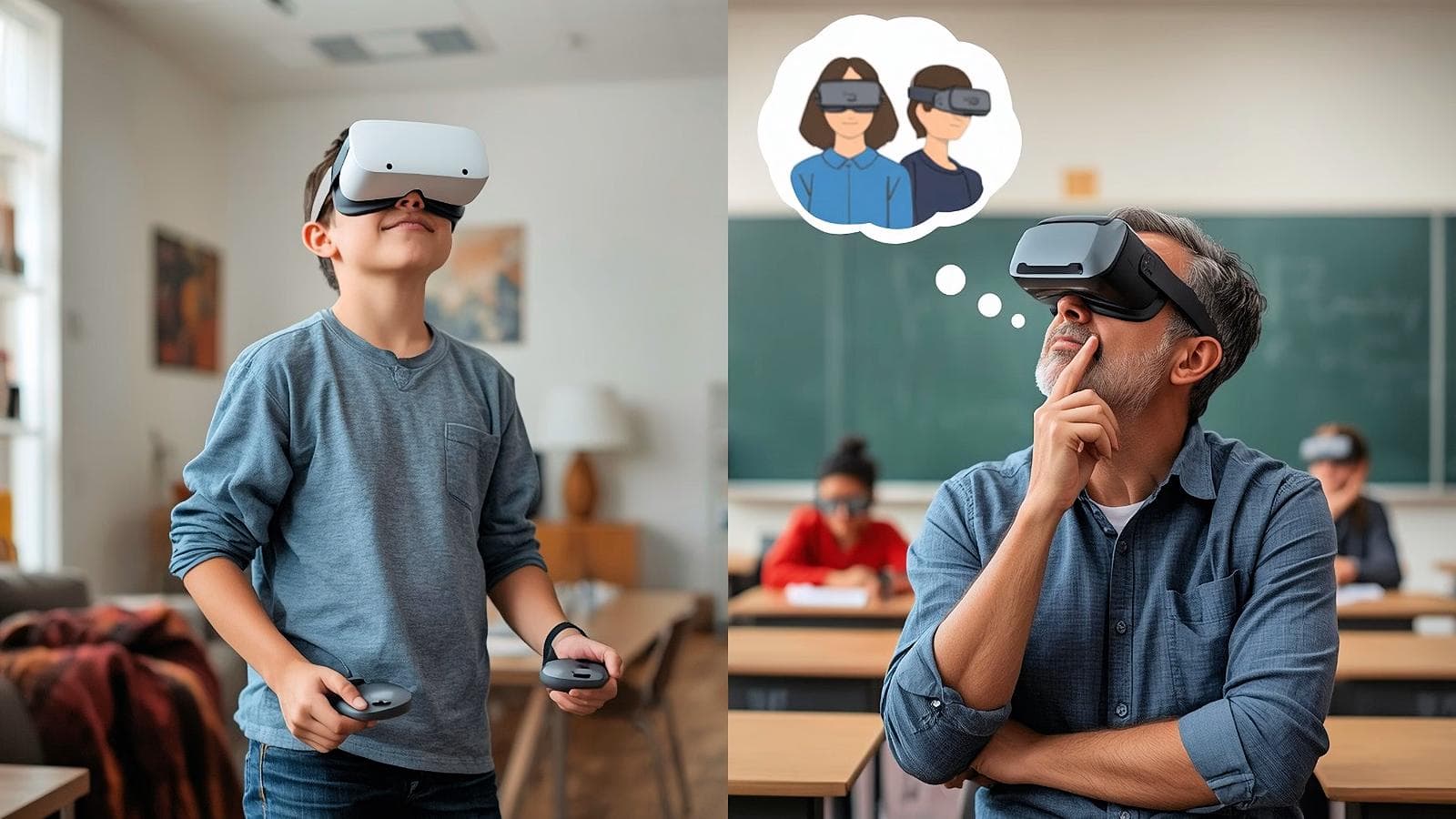
"My 13-year-old son has a VR headset, and he absolutely loves it!"
The story is almost always the same. The boy is completely immersed in a game, excited, engaged, and often reluctant to take the headset off. His father, perhaps a teacher himself, watches this enthusiasm and thinks:
Imagine if I could get my students this excited about learning.
It's a wonderful thought.
And, frankly, it's exactly the kind of thinking we should encourage from educators.
After all, teachers spend their careers looking for ways to engage students, inspire curiosity, and help young people develop a genuine interest in learning. Here is a technology that appears capable of commanding a young person's undivided attention.
The teacher then discovers research demonstrating that virtual reality can improve certain learning outcomes. The educational possibilities seem obvious.
The sentiment is right. The educational ambition is right. The reasoning is entirely understandable.
But somewhere between the living room and the classroom, a very important question has been skipped.
Is the device that works so well for a 13-year-old playing games at home actually appropriate for a school?
The assumption we rarely question
This is a surprisingly difficult distinction for people to make.
Consider the television. A television used in a living room can also be used in a classroom. The same is true of a conventional projector. Although commercial versions may offer different features and durability, the fundamental requirements are reasonably similar.
We have become accustomed to the idea that a consumer device can simply be carried into an educational setting and put to work.
But VR is different.
A modern consumer virtual reality headset is not simply a display strapped to someone's head. It may be a sophisticated computing platform incorporating cameras, microphones, positional tracking, behavioural data collection, internet connectivity, online accounts, software stores, and an ecosystem of services controlled by its manufacturer.
All of these capabilities may be perfectly reasonable in a gaming environment.
Some may also be valuable for specific learning objectives.
But a school has responsibilities that extend far beyond the enjoyment or satisfaction of a single user.
It must consider privacy, safeguarding, physical safety, accessibility, maintenance, teacher workload, data governance, reliability, and ongoing operating costs.
The requirements of one enthusiastic consumer are not the requirements of an institution responsible for hundreds or thousands of learners.
That distinction should be the beginning of the procurement conversation, not an afterthought.
Enthusiasm is not the same as learning
The 13-year-old's excitement is real.
It is also worth understanding what that excitement actually tells us.
It tells us that a particular experience is engaging. It does not necessarily tell us whether that experience produces sustained learning, whether the same engagement will transfer to educational content, or whether the hardware is suitable for everyday classroom use.
Research provides an important caution here.
A 2025 systematic review published in Virtual Reality, examining 50 studies of immersive VR in higher education, found that the evidence remains fragmented, with inconsistent learning outcomes and insufficient validated research in many areas.
The authors also identified a striking omission: of 44 studies considered for usability, only seven explored it.
Think about that.
We are enthusiastically studying how people learn inside VR, but far less consistently studying how practical these systems are to use in the institutions where that learning is supposed to happen.
Other research presents encouraging evidence for VR's educational potential. A 2024 systematic review in Computers & Education: X Reality found positive learning effects, particularly in environments supporting active engagement.
These findings are not contradictory.
Virtual reality can be effective for learning without every virtual reality system being appropriate for education.
And we must be careful not to confuse the excitement generated by a technology with the educational value generated by its use.
A great gaming experience is evidence of a great gaming experience.
It is not a school procurement evaluation.
The three questions the 13-year-old never needs to ask
The boy in the living room doesn't need to understand the privacy architecture of his headset. He doesn't need to calculate its five-year total cost of ownership.
He doesn't need to know whether a teacher can operate it independently, whether the school has sufficient Wi-Fi capacity, or how many students can use the system during a normal school day.
Nor should he.
He is 13 years old. He wants to enjoy his game.
His father, as an educator, may not have the technical expertise to evaluate every implication either. His profession is teaching, not necessarily data protection, device management, or information security.
That is why we have educational technology researchers, consultants, institutional decision-makers, procurement specialists, and industry experts.
And it is precisely why these professionals must examine three fundamental requirements.
1. Privacy: Who is actually benefiting from the data?
Modern VR systems can collect remarkably detailed information about their users, depending on their hardware capabilities, software, and configuration.
This is not a hypothetical concern.
In a 2020 study published in Scientific Reports, Stanford researchers demonstrated that participants could be identified from VR tracking data with approximately 95% accuracy among 511 individuals, using less than five minutes of tracking data per person.
This does not mean every VR manufacturer collects or exploits such data. It means that motion-tracking data can have significant identifying properties, even when conventional identifiers are absent.
And when a device is supplied by a company whose wider business includes advertising, social media, or extensive consumer-data processing, the questions surrounding data ownership, commercial interests, and institutional control deserve particular scrutiny.
Schools should know what information is collected, where it goes, who can access it, how long it is retained, and whether it can be used for purposes unrelated to learning.
The existence of a privacy policy does not automatically establish suitability for education.
Compliance is not a principle. It is a floor.
The more fundamental question is whether the learning objective requires the collection of that information at all.
Privacy should begin with the architecture of the system, not merely the promises attached to its operation.
2. Usability: Who makes the learning possible?
At home, the 13-year-old is often his own technology expert.
He knows how to launch games, navigate menus, troubleshoot problems, and recover when something goes wrong. He has a personal motivation to learn these things because he wants to play.
Now put that device in a school.
Who creates the accounts? Who manages software updates? Who troubleshoots connectivity? Who prepares the headset for the next student? Who ensures a learner can enter the correct educational experience? Who handles unexpected interruptions?
And most importantly, who gives up their time to make all of this happen?
Too often, the answer is the champion teacher. And that champion teacher tries to train other teachers.
This is a particularly expensive assumption because the teacher's time is arguably the most valuable resource in the classroom.
A VR solution that requires a knowledgeable facilitator to operate every session is fundamentally different from one that students can use independently.
Both may have educational value, but their institutional costs and scalability are not remotely the same.
A successful VR demonstration with an expert operating the system does not establish that the same system will work efficiently in an ordinary classroom.
If a technology requires an expert to make it easy, then it isn't yet easy.
A school should not need a VR enthusiast on staff to make virtual reality a normal part of learning.
3. Cost: The headset has a price. Using it has a cost.
The third issue is perhaps the most frequently misunderstood.
Consumer gaming hardware can appear remarkably inexpensive, particularly when compared with purpose-built institutional equipment.
Sometimes devices are heavily discounted, bundled with software, or supplied free for demonstrations and pilot projects.
Naturally, these offers are attractive to schools with limited budgets. But the purchase price is only one component of the cost.
There may also be costs for device administration, licensing, connectivity, content subscriptions, physical space, staff training, technical support, replacement cycles, and the teacher time required to supervise and facilitate each session.
A device that costs very little to acquire can become surprisingly expensive to operate.
Conversely, equipment with a higher initial price may prove substantially more affordable over its useful life if it requires less intervention and can be used more frequently.
UNESCO's 2023 Global Education Monitoring Report explicitly warned that the short- and long-term costs of educational technology are often significantly underestimated.
This matters enormously for VR, where the operational requirements of different systems can vary dramatically.
A free headset is not necessarily a free learning solution.
Schools should evaluate the cost of delivering learning, not simply the cost of acquiring hardware.
When the pilot becomes the prison
There is another consequence of the 13-Year-Old Son Issue that receives too little attention.
Institutional decisions often begin with a relatively small demonstration or pilot.
Someone has access to a popular gaming headset. A developer creates an interesting educational experience. A teacher enthusiastically introduces it to students.
The pilot goes well.
Photos are taken. Students smile. Administrators are impressed. Perhaps the project receives media attention or a research publication.
Before long, the device used in the pilot becomes the assumed hardware standard for subsequent projects.
Developers build for it. Researchers acquire more units. Teachers learn its particular procedures. Content investments become tied to the platform.
What began as a convenient choice becomes institutional dependency.
This is a form of vendor lock-in, and it can make later changes increasingly difficult.
Even when a different system might offer stronger privacy protections, lower operating costs, or simpler classroom deployment, switching can mean abandoning previous investments in software, training, and infrastructure.
The decision may never have been made through a comprehensive institutional evaluation.
It may simply have begun because somebody's son loved his gaming headset.
A pilot should test whether a solution is suitable. It should not quietly decide which solution the institution must use for years to come.
The damage is not necessarily apparent in the first successful demonstration.
It becomes apparent when the school attempts to move from a handful of enthusiastic participants to routine use across hundreds of students, dozens of teachers, and multiple locations.
That is when the requirements of institutional learning become impossible to ignore.
More specifications do not automatically mean more learning
The consumer virtual reality industry has made extraordinary technological progress.
Higher-resolution displays, increasingly sophisticated tracking, more cameras, more sensors, hand and body tracking, and greater processing power can all enable impressive experiences.
For certain educational objectives, these capabilities are essential.
Teaching surgery, welding, or other activities requiring precise physical movements may benefit enormously from six degrees of freedom (6 DoF) and appropriately designed interaction systems.
But learning is not exclusively a physical-skills activity.
Students also need to understand concepts, remember information, recognize patterns, develop language skills, evaluate situations, and make decisions.
Many of these objectives can be addressed through carefully designed, focused virtual reality experiences without complex movement tracking, elaborate controllers, or expansive physical environments.
A more technically sophisticated device is not inherently a better learning device.
In fact, additional capabilities can introduce new operational requirements, distractions, privacy considerations, and costs.
This does not make 6 DoF bad technology. Nor does it mean that simpler VR systems are universally preferable.
It means that the educational objective should determine the technology, rather than the technology determining what education is allowed to look like.
The right tool for the right job.
We would never insist that every student needs a powerful gaming computer to learn mathematics simply because powerful computers can do more.
Why should virtual reality be evaluated differently?
The responsibility of the experts
This brings us back to the teacher and his 13-year-old son.
I do not fault that teacher for seeing his child's enthusiasm and wanting to bring a similar experience to his students.
Quite the opposite.
I applaud him.
He recognizes the potential of virtual reality to engage learners, and he wants to harness that potential for something worthwhile.
What I find more troubling is when those who are expected to advise schools fail to look beyond the same consumer experience.
Researchers, educational technology specialists, industry consultants, and procurement advisers have a responsibility to ask more difficult questions.
They should be examining the complete learning system, not simply the headset's specifications or the attractiveness of its demonstrations.
They should be testing classroom usability, evaluating data practices, calculating realistic costs, examining educational outcomes, and distinguishing between technical possibilities and institutional requirements.
And they should be willing to challenge established assumptions, even when those assumptions are supported by the most recognizable brands in the industry.
This is particularly important when inexpensive hardware, sponsored pilot programs, free devices, or developer incentives influence which platforms become widely adopted.
There is nothing inherently wrong with accepting these opportunities.
But there is something wrong with treating their availability as evidence of educational suitability.
The teacher deserves good advice, not another demonstration.
We should not expect every educator to become a cybersecurity specialist, hardware engineer, software administrator, or procurement expert.
We should expect the people advising them to understand those considerations and bring them into the conversation.
That is what expertise is for.
What we believe at Sensible-VR
At Sensible-VR, our starting point has never been to recreate the consumer gaming experience in a classroom.
It has been to ask what learning environments actually need.
That means putting privacy, usability, and cost at the centre of the design, rather than attempting to address them after the system has already been built.
Our approach emphasizes offline-first operation, minimal dependence on accounts and connectivity, straightforward device management, short and focused learning experiences, and the ability for students to work independently.
We deliberately favour seated use in a swivel chair or standing in place with rotation, rather than requiring learners to roam around a classroom.
We support both 3 DoF and 6 DoF approaches where appropriate because different learning objectives require different tools.
This is not about claiming that a simpler headset is technically superior to a sophisticated gaming device.
It is about recognizing that technical sophistication and educational suitability are two different measures.
The best system is not necessarily the one that can do the most.
It is the one that can reliably accomplish the intended learning objective, within the real-world constraints of the institution, without introducing unnecessary burdens.
Most VR is built to make people say "Wow." Sensible-VR is built so schools can say "Yes."
The question we should have been asking all along
That 13-year-old boy has done nothing wrong.
His excitement is genuine. His father's ambition is admirable. The educational potential of virtual reality is real.
The problem begins when we allow those observations to substitute for a proper evaluation of institutional requirements.
And the consequences extend well beyond one school or one device.
When the industry repeatedly selects technology according to consumer popularity rather than institutional suitability, we risk building an educational VR ecosystem that is unnecessarily expensive, difficult to operate, and inaccessible to the very learners who could benefit most.
The true opportunity for virtual reality is not a spectacular demonstration in a well-funded laboratory, or an occasional learning experience organized by a dedicated technology champion.
It is making this extraordinary medium affordable, safe, accessible, and practical enough to become an ordinary part of learning, in schools and institutions around the world.
That requires more than powerful hardware.
It requires a different way of thinking.
We need to stop asking which headset the 13-year-old loves, and start asking which system the school can responsibly use, every day, for years.
The 13-year-old has already shown us that VR can capture attention.
Now it is the responsibility of the experts to ensure that education can actually use it.
Sources
- UNESCO (2023). Global Education Monitoring Report: Technology in Education, A Tool on Whose Terms? Examines evidence, costs, privacy, governance, and institutional technology choices.
https://gem-report-2023.unesco.org/technology-in-education/ - Stracke, C. M., et al. (2025). Immersive virtual reality in higher education: a systematic review of the scientific literature. Virtual Reality, 29, Article 64. Reviews the state of research, educational outcomes, methodological limitations, and usability.
https://doi.org/10.1007/s10055-025-01136-x - Conrad, M., Kablitz, D., & Schumann, S. (2024). Learning effectiveness of immersive virtual reality in education and training: A systematic review of findings. Computers & Education: X Reality, 4, 100053. Examines how particular forms of VR engagement relate to learning effectiveness.
https://doi.org/10.1016/j.cexr.2024.100053 - Miller, M. R., Herrera, F., Jun, H., Landay, J. A., & Bailenson, J. N. (2020). Personal identifiability of user tracking data during observation of 360-degree VR video. Scientific Reports, 10, 17404. Demonstrates the identification potential of VR movement data.
https://doi.org/10.1038/s41598-020-74486-y - U.S. Federal Trade Commission (2022). FTC to Crack Down on Companies That Illegally Surveil Children Learning Online. Explains requirements concerning educational data collection, use, retention, and security under applicable US children's privacy rules.
https://www.ftc.gov/news-events/news/press-releases/2022/05/ftc-crack-down-companies-illegally-surveil-children-learning-online - Poupard, M., Larrue, F., Sauzéon, H., & Tricot, A. (2025). A systematic review of immersive technologies for education: Learning performance, cognitive load and intrinsic motivation. British Journal of Educational Technology, 56, 5–41. Examines the relationship between immersion, cognitive load, motivation, and learning outcomes.
https://doi.org/10.1111/bjet.13503