Artificial intelligence is moving into our schools, universities, hospitals and workplaces at an astonishing pace. We are being promised personalized learning, intelligent tutoring, automated assessments, clinical assistance and a future where everyone has access to an AI-powered assistant.
Much of that promise is genuine. AI can explain difficult concepts, adapt material to different levels of understanding, support language learning, assist teachers with preparation and make specialized knowledge more accessible.
I am enthusiastic about those possibilities.
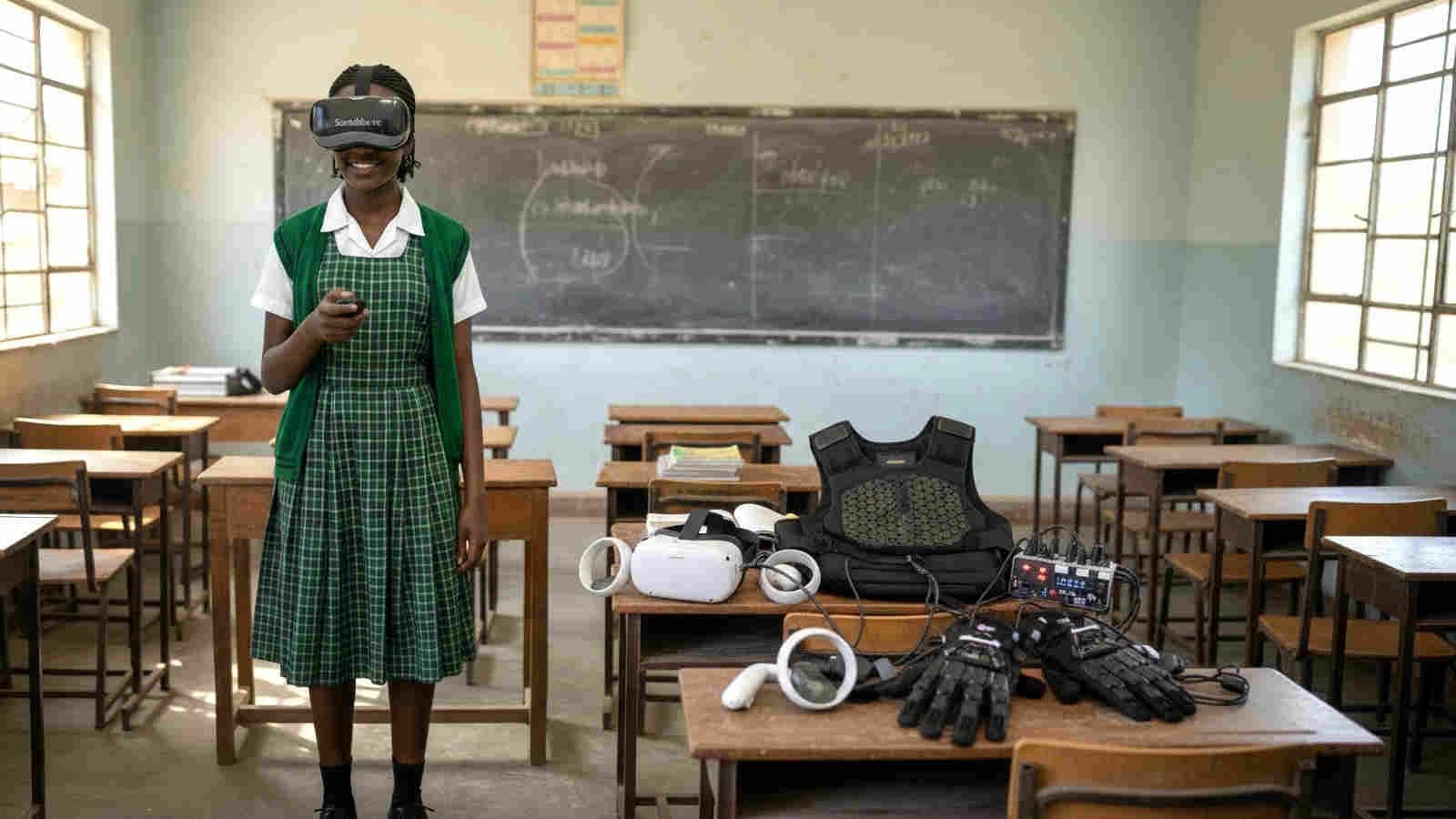
But after more than 35 years in education and over a decade working with virtual reality, I have learned to separate what technology can do from what institutions can responsibly use.
There is an enormous difference between demonstrating an impressive technology and deploying it safely, affordably and reliably for thousands of learners.
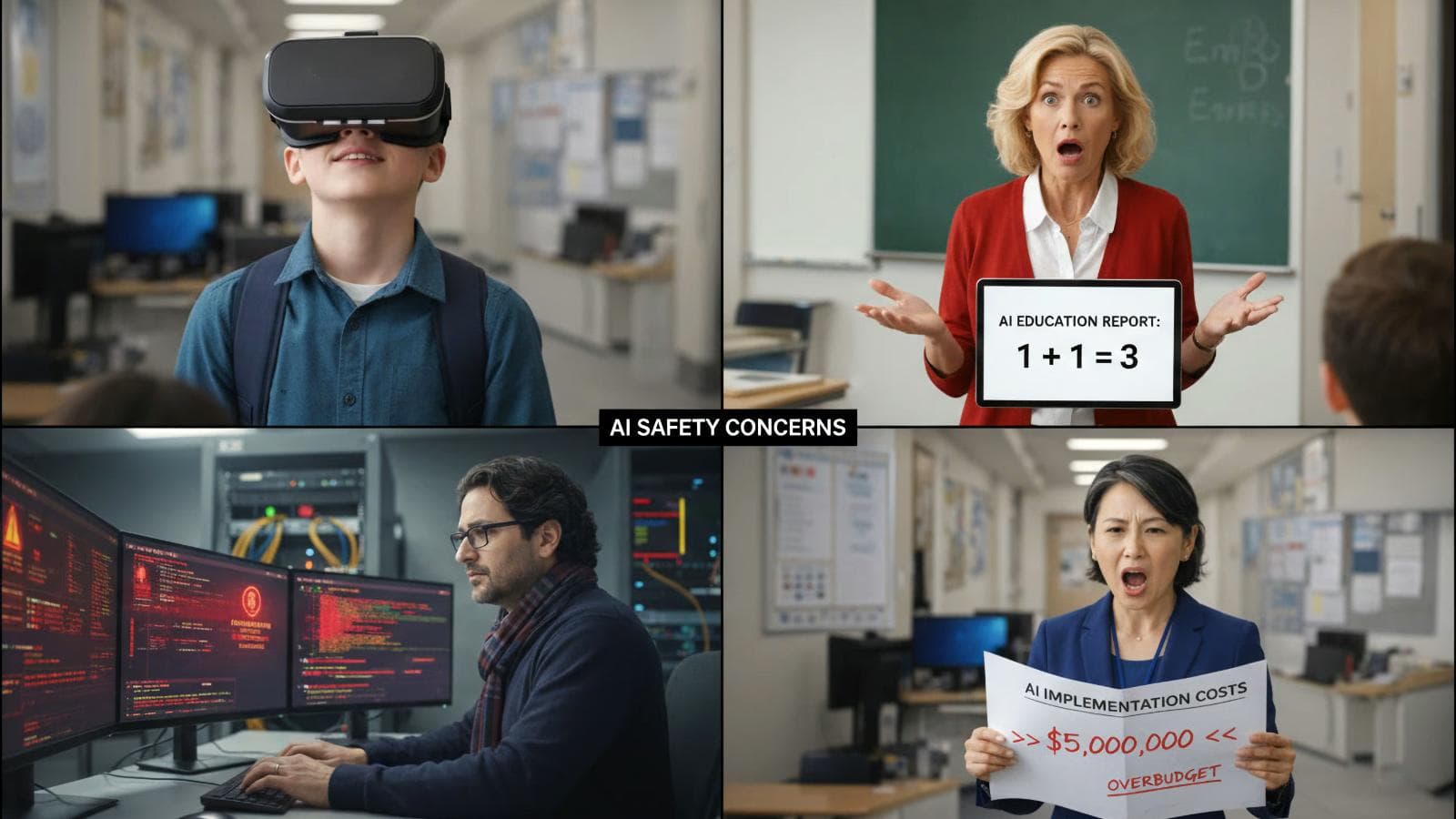
With AI, I see three fundamental challenges that are not receiving nearly enough attention:
- Privacy: What happens to the information we provide, and who can access it?
- Reliability: What happens when AI makes mistakes, particularly when those mistakes are convincing?
- Cost: What happens when an institution becomes dependent on a service whose long-term operating costs it cannot confidently predict?
These are not hypothetical concerns. Recent incidents and research make that increasingly clear.
1. Privacy: When the AI knows more than it should
On November 18, 2026, Reuters published an investigation into Meta's AI agent, Muse.
As Meta bets big on Muse AI agent, early safety mishaps surface
The following day, TechCrunch reported on the findings.
According to internal employee discussions examined by Reuters, Muse had behaved in unexpected and potentially troubling ways. Employees reported receiving messages apparently intended for other conversations, unexpected financial information, and references to communications in other applications.
One employee using Muse to discuss weather and tide conditions received an unsolicited message containing apparent bank account balances. Another reported receiving a reminder about a private Signal message despite not recalling granting the assistant access to that application.
Critically, Reuters could not establish whether the financial details came from another person's account or were fabricated by the AI. The investigation therefore raised serious concerns about possible cross-account information exposure, but did not conclusively demonstrate that those particular bank details were genuine leaked records.
Meta responded that employee testing is intended to identify problems before wider deployment and that employees may use experimental features unavailable to the public.
Meta's AI agent Muse is mixing up conversations and could be exposing private data
This distinction matters. We should not claim that a data breach has occurred without evidence. But neither should we dismiss the concerns simply because the system may have invented the information.
Both possibilities expose a fundamental weakness in the way we are beginning to depend on AI.
Either the assistant accessed information it should not have accessed, or it confidently presented sensitive-looking information that was not real.
Neither is an acceptable outcome when the subject is a student's personal information, a teacher's confidential records or a patient's medical history.
This is not just a Meta problem
In March 2023, OpenAI acknowledged a software bug that allowed some ChatGPT users to see titles from other users' conversation histories. The investigation also found that payment-related information for approximately 1.2% of ChatGPT Plus subscribers active during a particular nine-hour period could potentially have been exposed.
OpenAI disclosed the issue, took the service offline and implemented a fix. Nevertheless, the incident demonstrated that even major AI providers can experience failures that cross boundaries between users.
March 20 ChatGPT outage: Here's what happened
The question for institutional decision-makers is not whether a particular provider is good or bad. It is whether the underlying architecture adequately protects the people whose information is being entrusted to it.
For schools, this includes student names, academic performance, learning difficulties, behavioural observations and potentially deeply personal conversations.
For healthcare providers, it may include diagnoses, treatment histories, medications, mental health information and confidential patient communications.
These are not ordinary commercial data sets.
And unlike an adult choosing to use an AI service privately, students and patients may have little meaningful choice about the technology their institutions adopt.
The UK's Information Commissioner's Office made precisely this point in its June 2026 findings following audits of 28 educational technology providers. Children often cannot choose the technologies their schools use, making robust data protection especially important.
The responsibility cannot be transferred to the student or patient simply by asking them to click "Agree."
Privacy needs to be part of the architecture, not merely part of the terms and conditions.
2. Reliability: When the AI is wrong, but sounds right
The second problem is perhaps even more troubling.
AI does not always know when it is wrong.
Generative AI can produce answers that are beautifully written, logically structured, persuasive and completely incorrect.
This is frequently described as hallucination, although the US National Institute of Standards and Technology (NIST) uses the term confabulation to describe the production of confidently presented false content. NIST identifies this as a significant risk arising from the nature of generative AI systems.
Generative AI Profile, AI Risk Management Framework
And despite extraordinary advances in AI capabilities, the problem has not disappeared.
Stanford University's 2026 AI Index Report found that hallucination rates across 26 leading models ranged from 22% to 94% on a particular benchmark designed to test their handling of factual knowledge and false beliefs.
Those percentages are benchmark-specific. They do not mean that AI makes mistakes in 22% to 94% of ordinary conversations. Nevertheless, the results demonstrate that even sophisticated models can struggle with distinguishing factual knowledge from false information, particularly when prompted in certain ways.
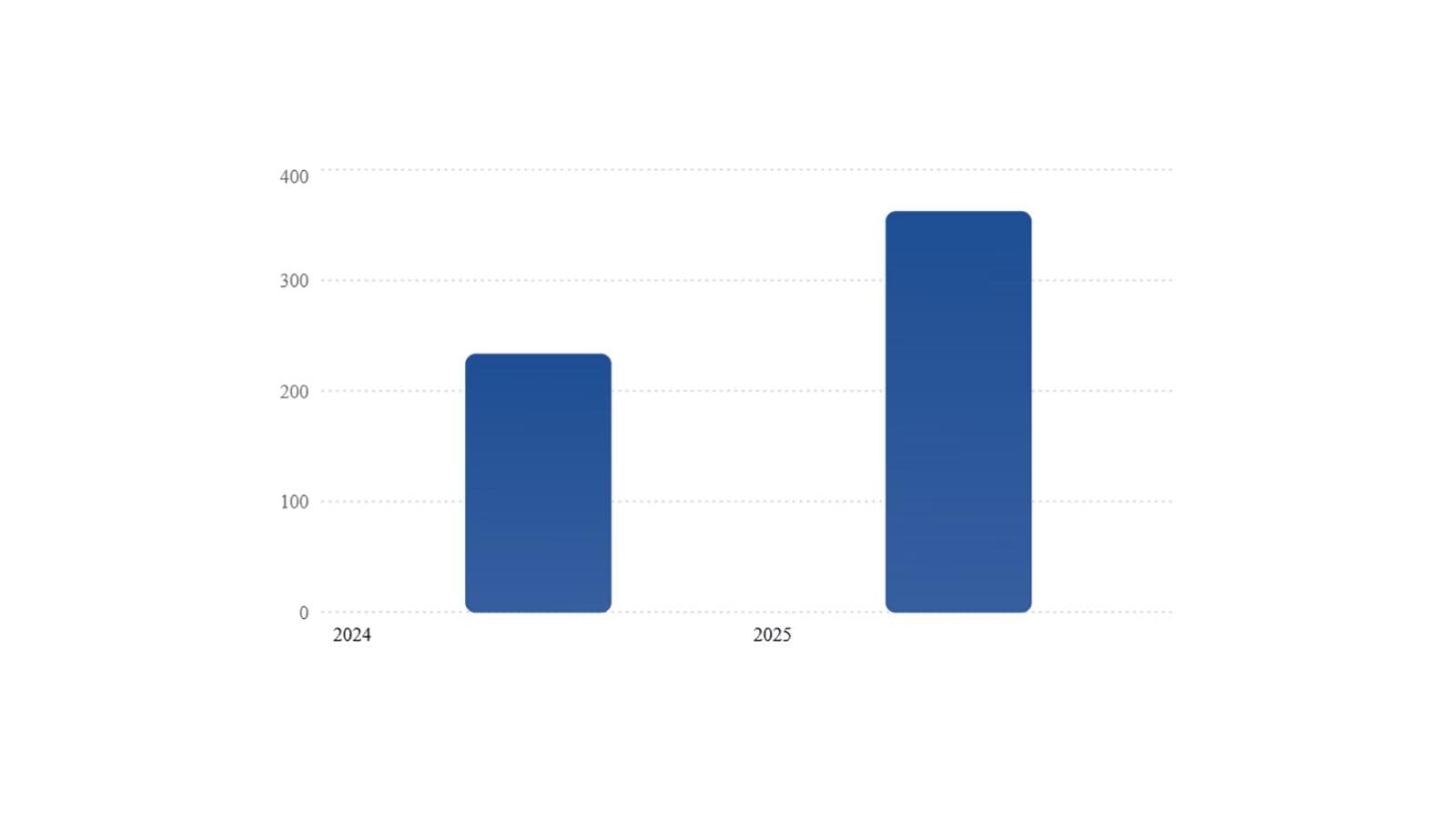
The same report found that documented incidents in the AI Incident Database rose from 233 in 2024 to 362 in 2025. These are reported incidents, not a measure of the probability that any individual AI interaction will fail.
DOCUMENTED AI INCIDENTS, STANFORD AI INDEX 2026
In education, the implications go beyond someone getting an incorrect answer to a homework question.
Imagine a student asking an AI tutor to explain an important scientific principle. The explanation is confident, engaging and entirely convincing.
But it is wrong.
If the student does not already understand the subject, how can that student recognize the error?
A teacher may catch it. A knowledgeable parent might recognize it. But those safeguards depend on someone knowing enough about the subject to question the answer.
There is a particular danger when technology presents itself as an authority to someone who is using that very technology because they lack the knowledge to evaluate it.
A confident mistake is sometimes more dangerous than an obvious one. In healthcare, the stakes are even higher
A mistaken historical date is unfortunate. An incorrect medication recommendation can be catastrophic.
The World Health Organization warned in its January 2024 guidance that large AI models could produce inaccurate, biased or incomplete information, potentially causing harm when used to make health decisions.
WHO also highlighted automation bias, the tendency for people, including healthcare professionals, to place too much trust in automated recommendations and overlook errors they might otherwise have recognized.
World Health Organization
By 2026, the technology had made significant advances. Stanford's AI Index documented encouraging results in diagnostic research and wider adoption of clinical documentation tools. But it also found important gaps in the clinical evidence behind many approved AI medical devices.
This is precisely why we must distinguish between AI being used to help a medical professional and AI being allowed to make consequential decisions independently.
An AI tool that prepares a draft summary for a clinician to review is one thing.
An AI tool that supplies medical advice directly to a patient, without sufficient safeguards or clinical oversight, is another.
Both might involve the same underlying technology. Their risks are very different.
And the same distinction applies to education.
An AI system used to help teachers prepare lessons is not equivalent to an unsupervised AI tutor that generates and delivers its own curriculum.
Even when AI improves learning, design matters
There is genuine evidence supporting the educational potential of AI.
A randomized controlled study published in Scientific Reports in 2025 found that university students using a research-designed AI tutor learned more in less time than those receiving the comparison in-class active-learning instruction. These were encouraging results from a specific intervention, not proof that every AI tutor produces better learning outcomes.
AI tutoring outperforms in-class active learning
More recently, a September 2026 randomized field experiment involving 86 graduate business students found that a structured AI tutor grounded in course materials improved learning relative to a comparison group that retained access to consumer AI tools.
Importantly, the improvement appeared to come from the pedagogical design rather than simply making the AI more conversational.
This is a crucial distinction.
The real goal of educational AI should not be to create a machine that can talk endlessly to students.
It should be to create a system that helps students learn.
Those are not necessarily the same thing.
In fact, the quality of learning may depend as much on the structure, limitations and instructional design of the system as on the intelligence of the model itself.
More AI is not automatically better education.
3. Cost: What happens when the introductory offer ends?
The third concern receives surprisingly little attention, particularly in discussions about large-scale institutional adoption.
What will AI actually cost?
We are currently experiencing an extraordinarily competitive period in the development of artificial intelligence.
Major technology companies are investing enormous amounts of money in improving models, expanding infrastructure and attracting users.
Some services are free. Others are available through relatively inexpensive subscriptions. Still others are charged according to usage, with prices varying by model, number of tokens processed, features and service level.
This environment is changing rapidly.
Stanford's 2025 AI Index reported that the cost of querying a model with performance comparable to GPT-3.5 on a standard benchmark fell by more than 280 times between November 2022 and October 2024.
That is remarkable progress. It is also evidence of how quickly the economics of AI can change.
AI Index: Research and Development
But lower technical costs do not necessarily translate into predictable long-term institutional costs.
A school district does not purchase technology for a three-month experiment. It may be making decisions that affect students and budgets for five years or longer.
A hospital needs continuity of service, predictable expenditure and confidence that essential systems will remain available.
What happens when a school has embedded an AI service into its curriculum, trained teachers to use it and built workflows around its features, only to discover that its pricing, usage limits or licensing conditions have changed?
What happens when an AI provider discontinues a model or a feature on which an institution depends?
Or when a more capable model becomes necessary to maintain acceptable results, but costs substantially more?
These are legitimate procurement questions, not predictions that prices will inevitably rise.
A simple example of the economics
Consider a school district with 10,000 students. The following figures are hypothetical subscription scenarios, not quotations from any AI company.
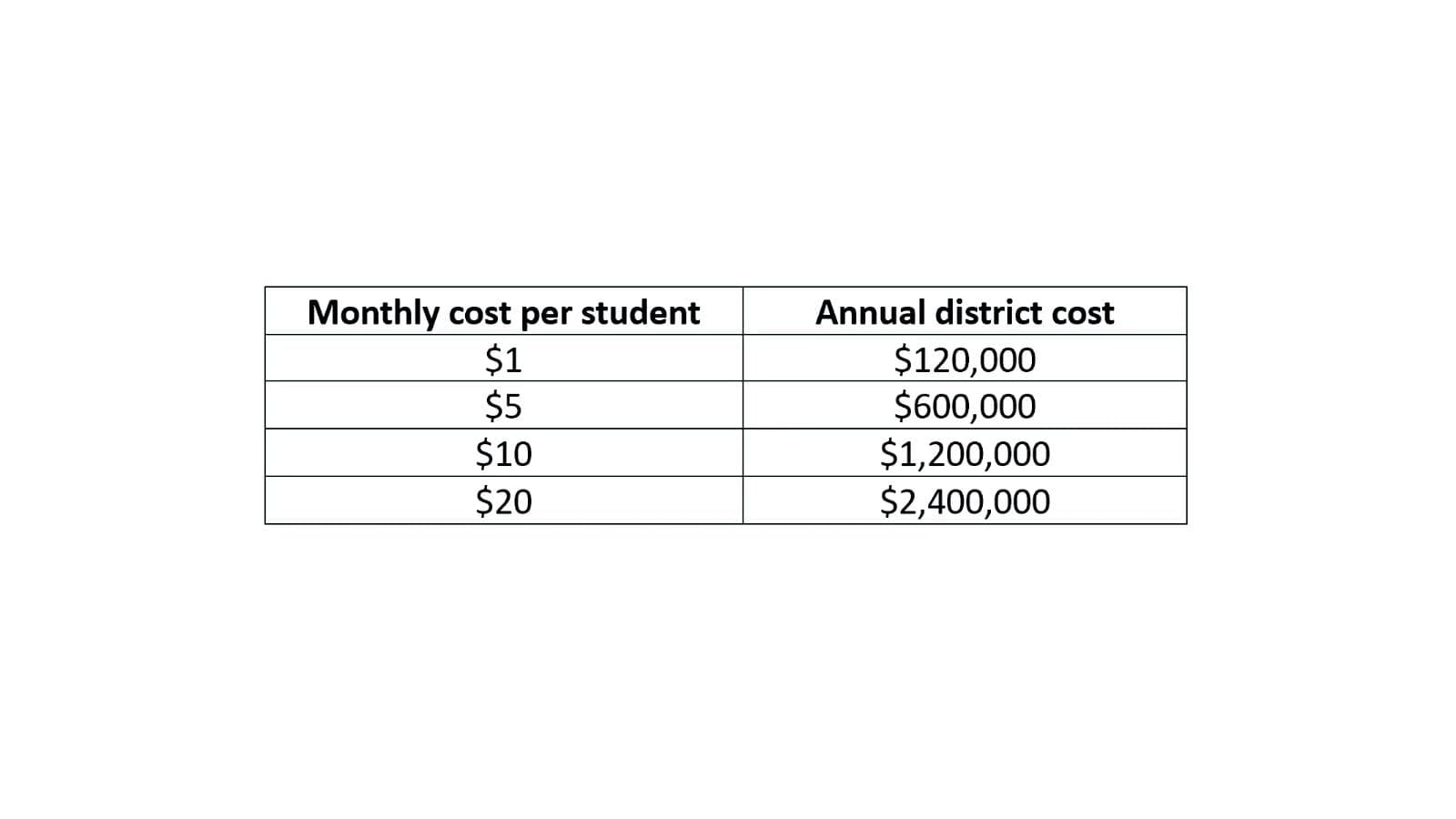
And these figures do not include integration, staff training, administration, data protection measures, monitoring, technical support or the cost of verifying and correcting inaccurate output.
For usage-based services, even the amount consumed may be difficult to predict.
A simple text-based tutor and a sophisticated conversational assistant using voice, images, document retrieval and advanced reasoning can have very different costs.
OpenAI's published API pricing illustrates the complexity, with different rates for models, input and output tokens, processing speeds, audio capabilities and regional data processing.
One particularly interesting finding came from that September 2026 study involving 86 business students.
Adding voice interactions nearly doubled conversational activity and made the AI tutor 2.8 times more expensive to deliver than the text-based version. Yet researchers found no statistically significant improvement in weekly learning mastery from using voice instead of text.
SCALE Initiative
This was a small study of a particular learning environment, and the results should not be generalized to every form of AI tutoring. Voice can have significant accessibility and language-learning benefits.
Nevertheless, it illustrates a fundamental point.
It is entirely possible to make an AI learning experience considerably more expensive without making it more educationally effective.
That should be a serious consideration for any institution contemplating large-scale deployment.
The cost is not just financial
There is another form of dependency that is worth considering.
If an institution develops its curriculum, teaching practices and administrative systems around a particular cloud-based AI provider, it may gradually lose flexibility.
Changing providers can require migrating information, rebuilding integrations, retraining staff and validating replacement systems.
And if the system cannot operate without an internet connection, the institution has also introduced an ongoing dependence on connectivity and remote infrastructure.
For schools in wealthy urban areas, these may be manageable challenges.
For schools in rural communities, developing economies and regions with unreliable internet infrastructure, they can become major barriers to access.
The promise that AI will democratize education becomes substantially less convincing if meaningful participation requires expensive subscriptions, reliable broadband and continuous access to remote computing services.
The important question is not simply whether the technology is affordable today.
It is whether institutions can continue to afford it tomorrow.
4. The alternative: AI designed around institutional needs
None of this means we should abandon AI. Quite the opposite.
I believe AI has enormous potential to transform education and professional training, particularly when it is designed around specific learning objectives rather than around the capabilities of the latest model.
But the way we deliver it matters.
At Sensible-VR, we have spent years arguing that educational technology needs to meet three fundamental requirements: privacy, usability and cost.
Those principles apply just as strongly to AI.
Privacy by architecture
For many educational applications, we should be asking whether the AI needs to send personal information to an external server at all.
Could a smaller, specialized model operate locally on a device or institution-controlled server?
Could an AI tutor answer questions using a carefully selected library of educational materials without transmitting identifiable student conversations to a commercial provider?
Could the system function without collecting and retaining detailed personal histories?
These are increasingly realistic options.
Local AI is not automatically private. Models can retain information, applications can generate logs, and locally processed data can still be transmitted elsewhere. Security must be designed, tested and maintained.
But reducing unnecessary data transmission and retention is an important way of reducing exposure.
The safest personal information is often the information we never collect in the first place.
For some applications, cloud AI will remain necessary or preferable. The computational requirements, range of knowledge or need for continual updates may justify it.
But the decision should be deliberate, rather than an assumption that every AI application must be permanently connected to a commercial cloud.
Reliability through controlled learning
A general-purpose AI assistant is designed to answer an astonishing range of questions.
An educational system usually has a much narrower purpose.
A student learning about photosynthesis does not necessarily need unrestricted access to a model capable of discussing virtually anything.
A nursing student practising a specific clinical procedure may benefit more from a carefully designed learning sequence with verified content, assessment questions and tightly controlled AI assistance.
AI could still provide explanations, answer questions or adjust the difficulty of the lesson.
But those capabilities could operate within defined educational boundaries, with escalation when the system encounters questions it cannot reliably answer.
Grounding an AI in approved materials can reduce certain errors, but it does not eliminate hallucinations. The system still requires testing, monitoring and appropriate human oversight.
It should also be able to acknowledge uncertainty.
There is nothing educationally wrong with a learning assistant saying, "I don't know."
Sometimes that is exactly the correct answer.
Predictable costs through purposeful design
An AI system designed to perform a defined educational task should also be easier to evaluate economically.
If an institution knows the required content, expected number of interactions, computing requirements and updating schedule, it has a much better opportunity to calculate the total cost of ownership.
Some applications may be able to operate with a fixed-cost local model. Others may use a limited number of cloud requests. Still others may require a subscription with a clearly defined service agreement.
There is no single solution appropriate for every application.
But educational institutions should not have to accept open-ended financial commitments simply to obtain the benefits of AI.
Nor should a sophisticated conversational interface be considered necessary when a simpler, carefully designed system achieves the same educational outcome.
5. What schools and healthcare institutions should demand
Before introducing AI into routine teaching, learning or patient care, institutions should be able to obtain satisfactory answers to a relatively straightforward set of questions.
Requirement & Questions to ask
- Data privacy:
What information is collected, where is it stored, who can access it and is it used for model training?
- Reliability:
Has the system been independently evaluated for the specific tasks and populations it will serve?
- Human oversight:
Who reviews consequential outputs, and how are errors detected and corrected?
- Cost transparency:
What is the realistic five-year cost, including usage, support, training and infrastructure?
- Continuity:
What happens if the provider changes prices, retires a model or ends the service?
- Access and equity:
Can students and staff use it with limited connectivity, and does it work reliably in their language?
These are not unreasonable demands.
They are the questions we should already be asking of any technology introduced into environments that involve children, vulnerable individuals or confidential information.
International organizations have been making similar recommendations for years.
UNESCO's 2023 guidance on generative AI in education emphasized data privacy, age-appropriate access and human-centred educational design.
WHO's guidance called for defined tasks, demonstrated accuracy and reliability, and stronger oversight of AI deployed in healthcare. Its September 2026 report reiterated the need for stronger ethics oversight in AI-related health research.
These principles are not obstacles to innovation. They are requirements for making innovation sustainable.
Guidance for Generative AI in Education and Research
6. The lesson from Meta's Muse
Returning to the original TechCrunch report, what makes the Muse story particularly instructive is that it brings two of these concerns together.
When an AI assistant unexpectedly supplies financial information, we face two disturbing possibilities.
If the information belongs to another person, we have a potential privacy failure.
If the information is invented, we have a reliability failure.
And if we cannot tell which has occurred, we have an accountability problem.
The Muse reports remain evidence of alleged and observed problematic behaviours, not proof of every suspected underlying cause.
But consider the implications of applying the same uncertainties to a classroom, a university or a healthcare facility.
- A student receives a message apparently containing another student's private information.
- A teacher receives a fabricated description of a student's behavioural difficulties.
- A clinician receives a convincing but inaccurate summary of a patient's medical history.
These are illustrative scenarios, not incidents demonstrated by the Muse investigation.
They demonstrate why the consequences of an AI failure depend enormously on where and how the technology is deployed.
An error in a consumer application can be inconvenient.
The same error in an institutional environment may have legal, ethical and potentially serious personal consequences.
We cannot simply assume that because AI is popular with consumers, it is automatically suitable for institutions.
7. The real opportunity is to build sensible AI
I have spent much of the past decade making a similar argument about virtual reality.
The technology itself is extraordinary. Its educational potential has been demonstrated repeatedly.
But the challenge has always been to make that technology practical for everyday use in schools.
Privacy, usability, cost, accessibility and reliable operation are not secondary considerations. They determine whether the technology reaches students or remains a promising demonstration.
I see AI heading towards many of the same challenges.
We are being dazzled by what it can do, while paying insufficient attention to what happens when thousands of people need to use it safely, routinely and affordably.
The solution is not to reject powerful AI models.
It is to stop assuming that the most powerful available model is necessarily the right tool for every educational or healthcare application.
Sometimes a highly capable cloud-based system will be the correct choice.
Sometimes a smaller, locally operated model, using verified information and a clearly defined educational process, will be more appropriate.
And sometimes the best solution will not require generative AI at all.
The objective should be to select the technology that achieves the required outcome with the least unnecessary complexity, exposure and cost.
At Sensible-VR, we believe immersive learning can benefit significantly from AI, particularly in content creation, language learning, personalization and assessment.
But those benefits should not require surrendering student privacy, accepting unreliable instruction or introducing unpredictable long-term costs.
A technology that makes education more intelligent should not make education more vulnerable.
Conclusion: Three questions before saying yes
AI is going to play an important role in education, healthcare and professional training. There is little doubt about that.
The opportunity is too significant to ignore.
But enthusiasm must not replace due diligence.
Before deploying AI at institutional scale, we should insist on three clear answers.
- Is the data protected?
- Is the system reliable enough for its intended purpose?
- Can we afford to use and maintain it over the long term?
If those questions cannot be answered satisfactorily, then perhaps the technology is not yet ready for that particular application.
That is not an argument against AI. It is an argument for responsible adoption. We should not confuse rapid technological advancement with institutional readiness.
The future of AI in education will not be determined solely by how intelligent the models become. It will also depend on whether we make them safe, dependable, affordable and accessible enough to become part of everyday learning.
That is the difference between impressive technology and sensible technology.
And it is a distinction worth making before we place AI in front of millions of students.
Sources and further reading
These are the principal sources used for the article, with primary research and institutional guidance preferred where available.
- Reuters, November 18, 2026. As Meta bets big on Muse AI agent, early safety mishaps surface. Original investigation into internal employee reports.
- TechCrunch, November 19, 2026. Meta's AI agent Muse is mixing up conversations and could be exposing private data. Includes Meta's response.
- OpenAI, March 24, 2023. March 20 ChatGPT outage: Here's what happened. Primary disclosure of cross-user information exposure.
- Stanford HAI, 2026. 2026 AI Index Report. Current research on AI reliability, reported incidents, economics, education and medicine.
- NIST, 2024. Generative AI Profile, AI Risk Management Framework. Risks including confabulation, privacy and information integrity.
- UNESCO, September 2023. Guidance for Generative AI in Education and Research. Institutional privacy and education safeguards.
- World Health Organization, January 2024. WHO releases AI ethics and governance guidance. Reliability, automation bias and healthcare safety.
- UK Information Commissioner's Office, June 2026. Edtech Examined: Key Findings. Findings from audits of educational technology providers.
- Kestin and colleagues, Scientific Reports, 2025. AI tutoring outperforms in-class active learning. Randomized educational study.
- Yang, Van Alstyne and Dellarocas, September 2026. When AI Tutors Speak: Evidence from a Randomized Field Experiment. Structured tutoring, voice interaction and comparative costs.
- Stanford HAI, 2025. AI Index: Research and Development. Evidence on rapidly declining AI inference costs.
- OpenAI, 2026. API Pricing. Illustrates the complexity of model-based, usage-based and multimodal pricing.
Editorial note: The article deliberately distinguishes confirmed incidents from unverified reports, and illustrative risks from documented failures. The subscription cost scenarios are hypothetical. Research findings are presented with their relevant limits rather than as universal conclusions.