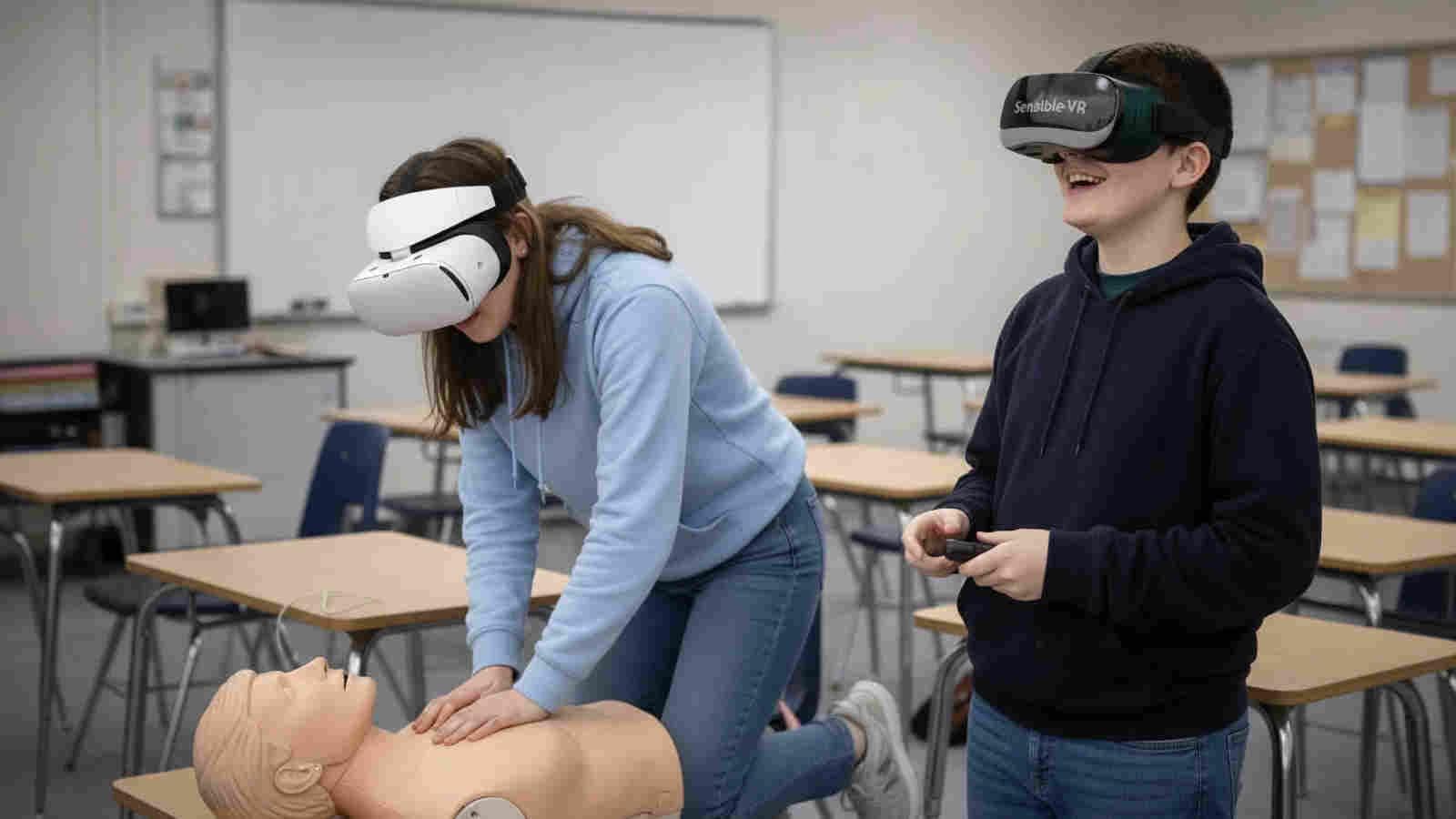
But CPR also demonstrates why we need to separate cognitive, psychomotor and affective learning.
A learner must recognize an emergency, assess what is happening, remember the correct sequence, make decisions, communicate with others, understand AED use, and develop the confidence to act. Those objectives do not necessarily require the learner's hands and body to be continuously tracked.
The Canadian Red Cross already makes a similar distinction in practice. Its CPR/AED Level C course can be delivered entirely in class or through a blended model combining online learning with an instructor-led component, while certification still requires learners to demonstrate physical skills and pass a knowledge evaluation.
So the question should not be:
“Does CPR require physical movement?”
Of course it does. The better question is:
“Which parts of CPR require us to track the learner's movement?”
When movement is the objective, use the right tool
For chest compressions, a physical manikin may actually be better than either type of headset. It provides real resistance, depth and recoil. There may also be situations where 6 DoF makes sense because positioning or physical interaction is genuinely part of what is being learned.
Use it there.
But recognizing cardiac arrest, assessing a scene, deciding what happens next, directing another person to call for help, locating an AED, responding to distractions or practising decision-making under pressure can all be immersive without requiring room-scale movement.
That is where 3 DoF becomes interesting.
There is also a privacy cost to movement
This is not theoretical. A Stanford study identified 95% of 511 VR users from less than five minutes of tracking data, while Nair and colleagues later identified users among a population of 55,541 with 94.33% accuracy from 100 seconds of head-and-hand motion data.
And there is an important additional question for training organizations:
If a 6 DoF device is even remotely connected to a social-media company, privacy stops being a feature comparison and becomes a governance problem. You are no longer simply buying a headset; you are entering an evolving data ecosystem whose accounts, policies, business practices and regulatory obligations may change long after the hardware has been purchased.
For all users, knowing that “a company currently says it will not do X” is very different from using a system designed so that X cannot be collected in the first place.
Now consider the economics
Here is a simple thought experiment. Assume:
- 3 DoF headset: $1,000
- 6 DoF headset: $1,000
The obvious procurement decision seems to be to buy one 6 DoF headset because it can theoretically do both jobs.
But hardware price is not Total Cost of Ownership.
Based on our Canadian education TCO modelling, let’s use an estimated additional $10 per 15-minute learner-session (actual estimated is $15.63 USD) when the learning requires the operational overhead associated with 6 DoF: preparing and checking the space, managing movement, additional supervision, setup and reset, controllers and related administration.
That is a planning assumption, not a published industry average. But it lets us test the economics.
Imagine an organization such as the Canadian Red Cross uses VR for just one 15-minute learning session per working day.
Using a conservative round number of 250 working days per year:
250 sessions × $10 = $2,500 per year
Over five years:
1,250 sessions × $10 = $12,500
The additional 3 DoF headset costs $1,000. That means the extra hardware cost is recovered after only:
- $1,000 ÷ $10 = 100 working days
- That is roughly 20 working weeks.
Over five years, the organization would avoid approximately $12,500 in additional operating burden. After paying $1,000 for the additional 3 DoF headset, the theoretical net advantage is:
$11,500.
And remember the assumption: only one fifteen-minute session per working day.
If an organization trains multiple people throughout the day, the difference compounds very quickly. The exact dollar figure will vary. The important point is that a seemingly minor recurring operational cost can dwarf the purchase price of the hardware.
Sometimes two headsets really are cheaper than one
This is the counterintuitive part.
Buying a 3 DoF headset and a 6 DoF headset may ultimately cost less than buying only the seemingly “more capable” device and forcing every learning experience through its more expensive operating model.
- Use 6 DoF when movement itself is important.
- Use a manikin when physical feedback is important.
- Use 3 DoF when the objective is observation, understanding, recognition, judgement, decision-making or confidence.
CPR does not weaken the 99–1 argument. It demonstrates why the distinction matters.
The 1% deserves the technology it genuinely needs. It just should not dictate the cost, complexity, and privacy exposure of the other 99%.
Sources
- Canadian Red Cross. “CPR & AED Course.” Course content, blended delivery, skills demonstration, and written knowledge evaluation. (Canadian Red Cross)
Canadian Red Cross — CPR & AED Course - Canadian Red Cross. “Do I need to demonstrate CPR in-class to become certified?” Confirms CPR skills must be demonstrated on a manikin during a CPR/AED scenario. (Red Cross Canada)
Canadian Red Cross — CPR Skills Demonstration - Miller, M. R., Herrera, F., Jun, H., Landay, J. A., & Bailenson, J. N. (2020). “Personal identifiability of user tracking data during observation of 360-degree VR video.” Scientific Reports, 10. Study of 511 participants; 95% identification accuracy using less than five minutes of VR tracking data. (Nature)
Scientific Reports — Miller et al. - Nair, V., Guo, W., Mattern, J., Wang, R., O’Brien, J. F., Rosenberg, L., & Song, D. (2023). “Unique Identification of 50,000+ Virtual Reality Users from Head & Hand Motion Data.” 32nd USENIX Security Symposium. Study of 55,541 users; 94.33% identification accuracy from 100 seconds of motion data after model training. (USENIX)
USENIX — Nair et al.