I believe studies and scholarly discussions such as Reimagining Dental Education: Integrating Digital Technologies for a Global, Digitally Native Generation, published in the European Journal of Dentistry, are extremely important to the advancement of VR in education.
The researchers deserve recognition for examining the potential of immersive technologies, and particularly for acknowledging the challenges of cost, sustainability, accessibility, and equitable implementation.
But I have a concern. And it is one that extends well beyond dentistry.
In our enthusiasm to demonstrate how VR can develop psychomotor skills, we risk choosing the most sophisticated, expensive, and operationally demanding route into education. In doing so, I fear we may inadvertently push VR out of relevance for the vast majority of learners.
We become so focused on what the technology can do that we lose sight of what education actually needs it to do.
Learning to Perform Is Only Part of Learning
There is no question that psychomotor skills are important in dentistry. A dentist must develop precise hand movements, tactile sensitivity, spatial awareness, and the ability to execute complex procedures safely.
Haptic simulation, with force feedback and realistic physical interaction, can be tremendously valuable in developing these abilities. I fully support its use where the learning objective demands it.
But consider everything a student must learn before picking up a dental instrument.
Students must first learn to identify anatomical structures, understand disease processes, interpret patient information, recognize potential complications, evaluate alternatives, and make sound decisions.
They need to understand why a procedure is necessary, when it is appropriate, what might go wrong, and how to respond.
They must remember, recognize, evaluate, and exercise judgement.
These are not secondary educational objectives. They are foundational to becoming a competent healthcare professional.
And VR offers extraordinary opportunities to support every one of them.
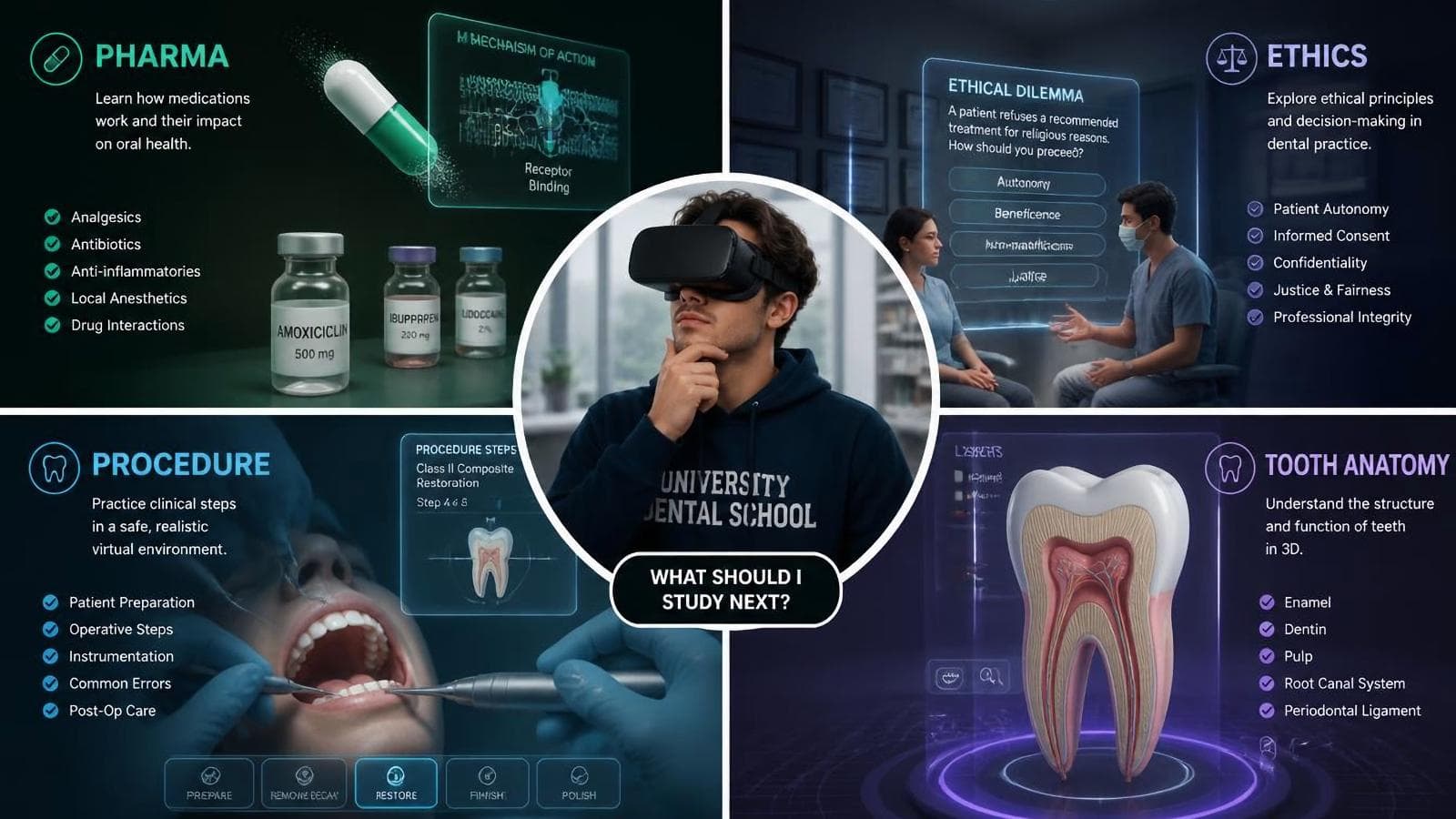
Imagine a student exploring the anatomy of a tooth, moving through its internal structures, examining how disease progresses, or learning to identify abnormalities. Imagine presenting realistic patient scenarios in which the learner must recognize symptoms, evaluate clinical information, and make decisions.
All within a focused environment, free from classroom distractions and the judgement of peers.
These experiences do not necessarily require expensive haptic systems, elaborate tracking technology, sophisticated controllers, or dedicated simulation laboratories.
In many cases, they can be delivered through simple, affordable VR experiences, completed independently in just a few minutes.
And that brings me to the problem.
Have We Made VR Unnecessarily Expensive?
The paper rightly identifies cost, infrastructure, faculty training, and technical support as significant barriers to widespread adoption.
But I would encourage researchers to ask an additional question:
How many of these barriers are inherent to VR, and how many have we created through our technology choices?
A sophisticated haptic simulation system may be exactly the right tool for learning a complex physical procedure.
But does a student need that same system to understand dental anatomy? To recognize signs of disease? To learn the sequence of a procedure? To make a clinical decision?
Of course not.
Yet when research, demonstrations, and discussions of educational VR concentrate heavily on these sophisticated applications, they risk creating the impression that this level of technology is what schools must purchase to benefit from immersive learning.
For institutions with substantial budgets, dedicated facilities, and technical support, that may be feasible.
For many other institutions around the world, it is not.
And we should be very careful about defining the future of an educational technology in a way that excludes most of its potential users.
The Most Expensive Part of VR Isn't the Headset. It's the Teacher.
This is a point I have made repeatedly over my years working in immersive education.
We frequently discuss the purchase price of VR hardware while largely overlooking the cost of actually using it.
A system requiring a facilitator to supervise students, technicians to manage equipment, specialized facilities, extensive professional development, and frequent maintenance carries costs that extend far beyond the initial hardware purchase.
Those costs accumulate with every learning session.
A headset has a price. Using it has a cost.
If a student needs an instructor to prepare the equipment, launch the application, supervise the experience, and reset everything for the next learner, that instructor's time must be included in the total cost of delivering the lesson.
This is not an argument against instructor-led learning. Skilled educators are indispensable, particularly when teaching complex clinical procedures.
It is an argument against unnecessarily consuming their time on learning activities students could readily complete independently.
If a student can spend ten minutes reviewing anatomical structures or practicing clinical decision-making without a facilitator, the instructor becomes available for the things that genuinely require their expertise.
That is an educational advantage, not simply a financial one.
Accessibility Is More Than the Ability to Purchase Equipment
The authors appropriately emphasize equity, global collaboration, and widening access to educational technologies.
I strongly agree with that ambition.
But accessibility cannot be measured simply by whether a university can afford to purchase a simulation system.
We must also ask whether students can use it regularly.
Can a learner access the experience independently? Can it be used repeatedly throughout the academic year? Does it require a reliable internet connection? Can it function without specialized technical support? Can it be deployed in institutions with limited budgets and infrastructure?
And importantly, can it protect the learner's privacy without requiring extensive collection of personal or behavioural data?
These are not minor operational considerations. They determine whether technology becomes a routine educational resource or remains an occasional demonstration.
I would much rather see a student have ready access to a simple, effective immersive learning experience several times a week than see a highly sophisticated system that students can access only occasionally.
There is certainly a place for both.
But availability is itself an important part of educational value.
A technology that is theoretically effective but rarely accessible cannot deliver its full potential.
We Need to Research the Simplest Effective Solution
One particularly encouraging aspect of this paper is its recognition that we need stronger longitudinal evidence demonstrating sustained educational and clinical benefits.
I agree wholeheartedly.
But I would go further.
Rather than concentrating primarily on whether increasingly sophisticated simulation systems improve performance, we should also investigate whether simpler immersive approaches can deliver comparable outcomes for the learning objectives that do not require physical interaction.
For example, consider a program in which students first learn anatomy, disease processes, diagnostic reasoning, and procedural understanding through short, independent VR modules.
They subsequently progress to haptic simulation for fine motor skills, and finally to supervised physical and clinical practice.
Would this combination produce better-prepared students? Would they require less supervised simulation time? Would their knowledge retention improve? Could institutions serve more students with the same resources?
These are questions worth investigating.
Researchers should examine not only learning outcomes, but also the cost per learner, required instructor time, frequency of access, infrastructure requirements, and long-term sustainability.
We might discover that the most sophisticated solution is essential for a small proportion of learning objectives, while a much simpler approach adequately serves many others.
The goal should never be to use the most impressive technology available. It should be to use the simplest technology capable of delivering the desired learning outcome.
An Opportunity, Not a Criticism
I want to return to the original paper because I believe its authors are asking many of the right questions.
Their attention to equity, sustainability, and the need for evidence-informed implementation is welcome. Their recognition of the barriers facing less-resourced institutions is particularly important.
My concern is with the direction in which the broader industry may interpret and act upon this research.
If we continue to associate educational VR primarily with advanced simulation, sophisticated haptics, and expensive institutional installations, we risk turning an extraordinarily accessible learning medium into a specialized tool available only to well-funded institutions.
That would be a tremendous missed opportunity.
I have spent more than 35 years in education and over a decade working with VR. What continues to excite me is not how technologically sophisticated we can make an immersive experience.
It is how readily we can put meaningful learning into the hands of students who might otherwise never have access to it.
A student in a rural school, a vocational college with limited resources, or a university in a developing economy deserves access to the same opportunities to understand, explore, recognize, and make decisions as a student attending a well-funded institution.
We should not make advanced equipment a prerequisite for experiences that do not need it.
It Is Time to Broaden the Conversation
The real potential of VR in education extends far beyond psychomotor training.
It includes focused attention, individual exploration, understanding, recognition, recall, decision-making, and the ability to learn independently in an environment free from distractions and peer judgement.
These are powerful educational benefits, applicable not only to dentistry, but to nursing, medicine, engineering, vocational training, and conventional classroom subjects.
They are also benefits that can often be delivered using comparatively simple, affordable technology.
We need research that reflects the breadth of these opportunities, and we need researchers, educators, and technology developers to work together in identifying the most practical approach to each learning objective.
Not every learning experience needs six degrees of freedom, haptic feedback, or a dedicated simulation laboratory.
Sometimes the most powerful educational technology is the one that simply works, is readily available, and stays out of the learner's way.
If our ambition is to make immersive learning accessible to students worldwide, we must stop measuring progress solely by how much technology we can add, and start measuring it by how many learners we can meaningfully reach.
The future of VR in education should not be defined by the sophistication of the equipment.
It should be defined by the accessibility and quality of the learning it delivers.
Sources
- Palotie, U., et al. (2026). Reimagining Dental Education: Integrating Digital Technologies for a Global, Digitally Native Generation—A Perspective. European Journal of Dentistry, 20(4), 1091–1100. https://doi.org/10.1055/s-0046-1823144
- Algarni, Y. A., et al. (2024). The impact of virtual reality simulation on dental education: A systematic review of learning outcomes and student engagement. Journal of Dental Education, 88(11), 1549–1562. https://doi.org/10.1002/jdd.13619
- Bevizova, K., et al. (2024). Is virtual reality enhancing dental anatomy education? A systematic review and meta-analysis. BMC Medical Education, 24, 1395. https://doi.org/10.1186/s12909-024-06233-0
- Orlańska, A. I., et al. (2022). Virtual reality as a novel approach for dental students' education: A preliminary survey study. Journal of Dentistry, 121, 103967. https://doi.org/10.1016/j.jdent.2022.103967