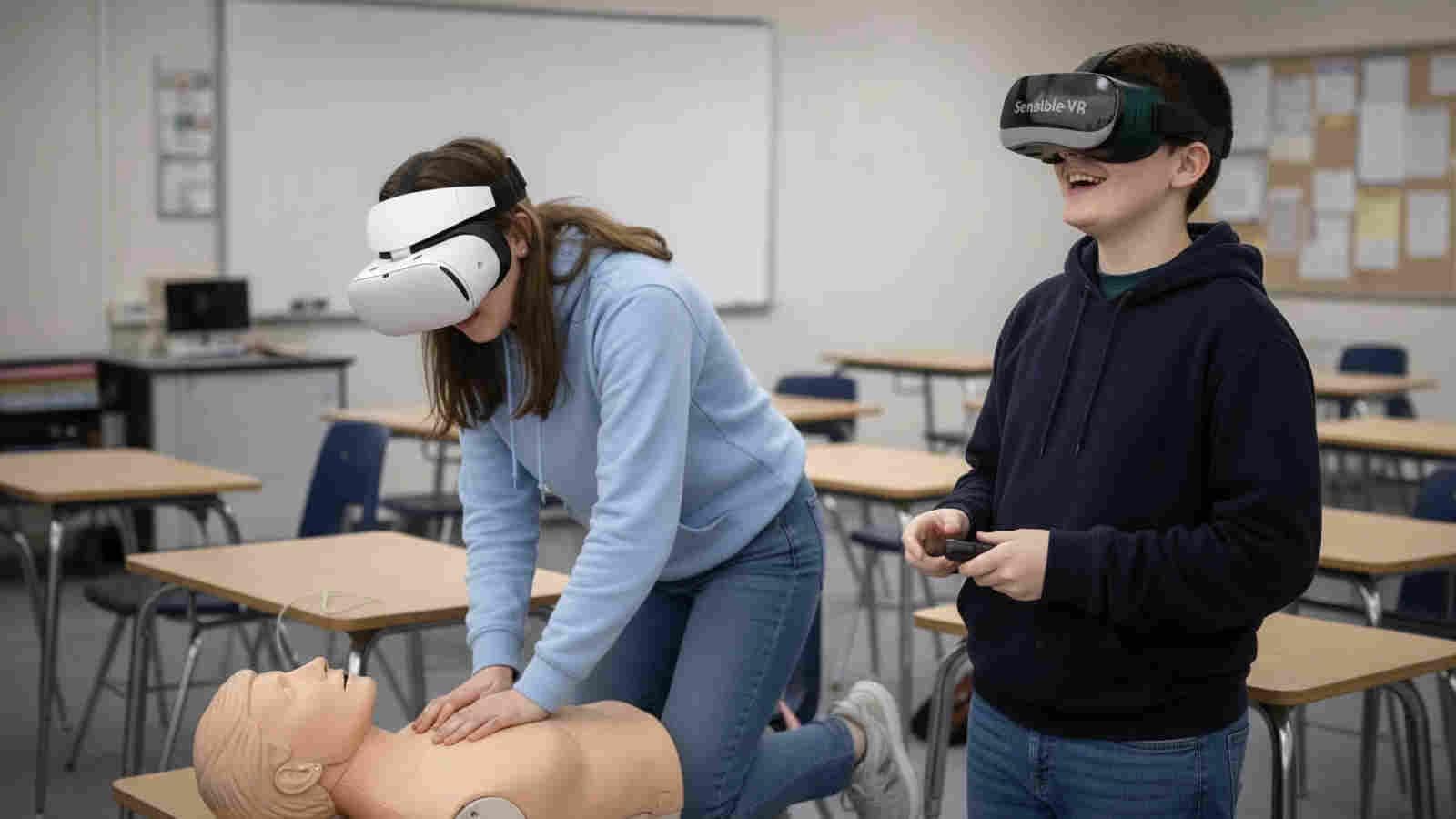
There is a tendency in the virtual reality industry to evaluate educational VR through a remarkably narrow lens.
Can the learner pick something up? Manipulate an object? Perform a physical procedure? Move their hands naturally? Interact with a virtual environment in ways that closely resemble the physical world?
These are perfectly legitimate questions. Physical skills matter enormously, and virtual reality has considerable potential for developing them.
But there is a problem.
Somewhere along the way, we seem to have confused the ability to perform a physical action with the much broader process of learning.
What about understanding? Remembering? Recognizing? Evaluating information? Making decisions? Developing confidence? Applying judgement? Practicing a conversation? Exploring an unfamiliar environment? Preparing for a difficult situation?
What about focused attention, free from distractions? The ability to make mistakes without an audience? The freedom to repeat an experience as often as necessary, without asking permission or waiting for an instructor?
And perhaps most importantly, what about access to learning whenever it is needed?
These are not secondary educational objectives. They represent an enormous part of what education actually does.
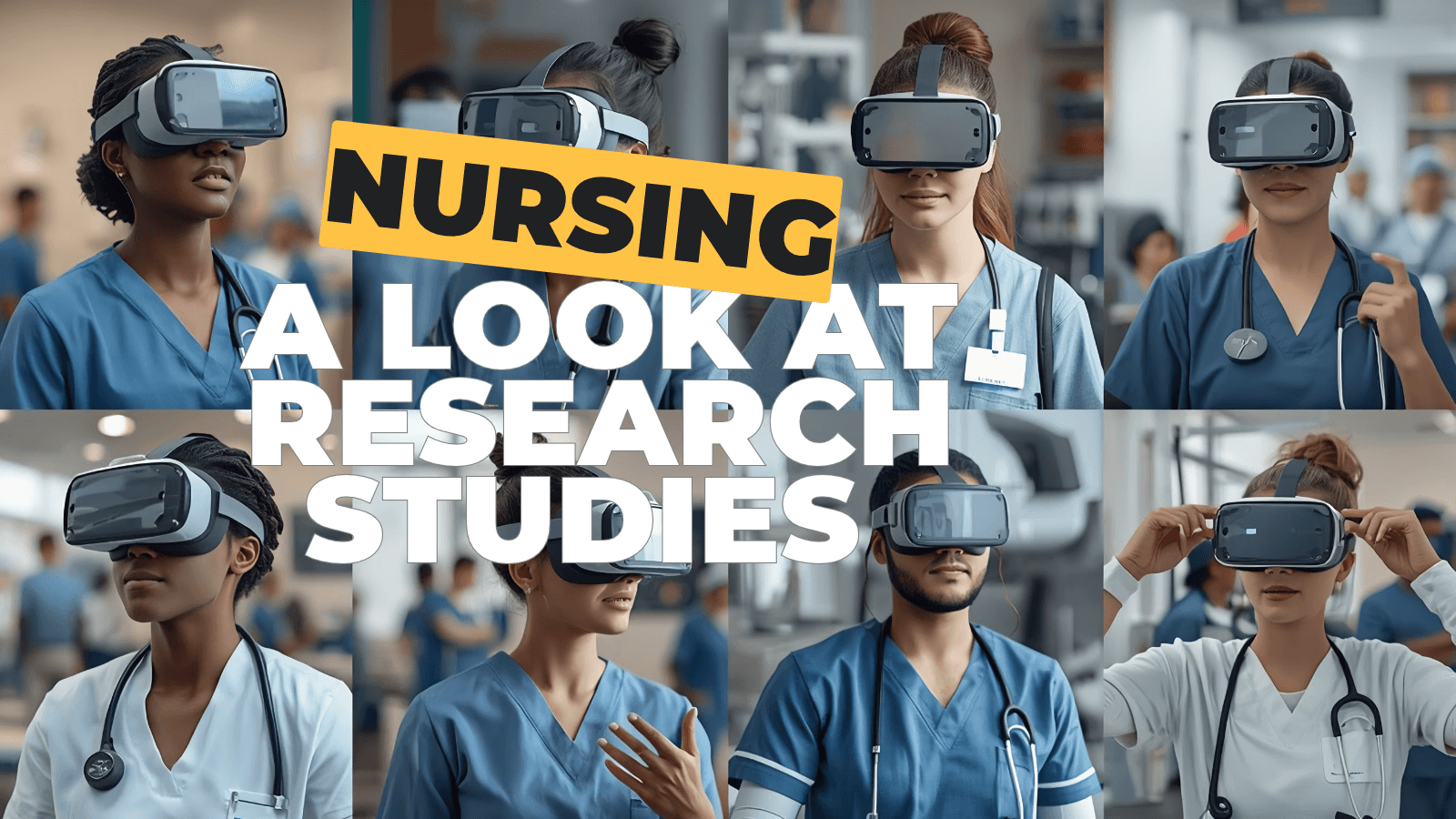
A recent scientific review involving more than 2,000 nursing students offers an interesting reminder of why we should stop treating physical interaction as the defining measure of educational VR.
A Study Worth Paying Attention To
Published in May 2026 in the Journal of Nursing Management, a systematic review and meta-analysis by Xia Li and colleagues examined 20 randomized controlled trials involving 2,063 nursing students.
The researchers investigated the effectiveness of immersive virtual reality across three domains of Bloom's taxonomy:
- Cognitive: Knowledge, understanding and intellectual processes.
- Psychomotor: Physical skills, coordination and procedural performance.
- Affective: Attitudes, beliefs and other psychological aspects of learning, including self-efficacy.
This distinction is important because educational effectiveness cannot reasonably be reduced to a single measure.
The findings were revealing.
Knowledge acquisition: Virtual reality produced a statistically significant improvement, with a standardized effect size of 0.33.
Physical skill performance: The estimated effect favoured VR, but the improvement was not statistically significant. The evidence was too uncertain to establish a reliable benefit.
Self-efficacy: VR produced a statistically significant improvement, with a standardized effect size of 0.38.
The researchers did not establish significant improvements in satisfaction or confidence, measured separately from self-efficacy.
These are standardized effect sizes, not percentage improvements.
The findings suggest that immersive VR can benefit knowledge acquisition and students' beliefs about their ability to perform tasks, while its contribution to physical skill development remains less certain.
There are important qualifications. The researchers rated the certainty of evidence for knowledge acquisition as low and for skill performance as very low. Results varied substantially between studies, and the evidence does not establish that VR is ineffective for physical skills.
Nevertheless, the distinction between learning domains deserves attention.
VR may offer some of its most valuable educational benefits in areas that receive considerably less attention than physical interaction.
The Industry's Fascination With Hands
Spend time around educational VR demonstrations and a familiar pattern emerges.
The learner reaches for something. Picks it up. Turns it over. Pushes a button. Assembles a component. Performs a procedure.
The demonstration is impressive, and sometimes the educational application is genuinely excellent.
But the ability to manipulate something is not, by itself, evidence that learning has occurred.
Consider a student preparing to become a nurse.
Before inserting an IV catheter, the student must understand anatomy, recognize potential complications, identify appropriate equipment, remember procedures, evaluate risks and make decisions about patient care.
The physical procedure is important. Nobody should suggest otherwise.
But it represents only one component of the learning required to perform that procedure competently.
A virtual environment may be exceptionally useful for understanding the anatomy, recognizing an unsafe situation, rehearsing the sequence of decisions, or identifying when a procedure should not proceed.
None of these objectives necessarily requires the learner to physically manipulate virtual objects in six degrees of freedom.
And when fine motor skills are the objective, the limitations of the technology become especially important.
The nursing review identified the absence of realistic tactile feedback, force feedback and sufficient deliberate practice as possible explanations for the uncertain results in physical skill performance.
A virtual hand may appear to grasp a needle perfectly. That does not mean the learner has developed the tactile sensitivity required to use a real one.
Tracking a hand is not the same as teaching a hand.
This is not an argument against 6 DoF. For learning objectives involving spatial movement, coordination and physical procedures, 6 DoF can be entirely appropriate.
It is an argument against assuming that more tracked movement necessarily produces more learning.
The Extraordinary Value of Learning Without an Audience
Another finding deserves considerably more attention.
The researchers identified a statistically significant improvement in self-efficacy.
Self-efficacy is not simply whether someone enjoys an experience or feels generally confident. It concerns their belief in their ability to accomplish particular tasks.
That distinction matters.
- Imagine a student who struggles to speak English in front of classmates.
- Or a young person preparing for an unfamiliar social situation.
- Or an employee learning how to respond to a workplace emergency.
- Or a nursing student trying to remember the correct sequence of actions when something goes wrong.
In each case, the learner may benefit from practicing privately, making mistakes, trying again and developing an understanding of what to do.
- There is no requirement that someone watch every attempt.
- There is no requirement for an audience.
- And there is no educational principle suggesting that embarrassment is a prerequisite for learning.
A learner should be able to make a mistake without having to make it in public.
This is one reason we place considerable value on individual, judgement-free learning at Sensible-VR.
It is important to distinguish our design philosophy from the research findings. The nursing study did not establish that privacy or freedom from observation caused the improvements in self-efficacy.
But the findings raise worthwhile questions about how environments designed for private, repeatable practice might support students who are reluctant to participate in more public learning situations.
For many learners, the opportunity to try again without judgement may be every bit as important as the ability to reach out and touch a virtual object.
Focused Attention Is Not a Minor Feature
There is another aspect of virtual reality that is frequently underappreciated.
When designed appropriately, VR can remove a significant portion of the visual distractions competing for a learner's attention.
The classroom disappears.
The surrounding activity disappears.
The student is presented with a carefully constructed learning environment containing the information, situations and activities relevant to the objective.
That does not guarantee attention or learning. Poorly designed VR content can be distracting, confusing or overwhelming.
But it creates an opportunity.
Rather than continually trying to compete for attention, educators can design an experience in which the learner's attention is directed toward the task.
This is particularly relevant when the objective involves understanding a concept, examining a situation, listening carefully, practicing language, recognizing something important or making a decision.
These are meaningful forms of interactivity.
- A student choosing the correct response in a virtual conversation is interacting.
- A learner identifying a dangerous condition in a workplace is interacting.
- A student exploring an ecosystem, examining its relationships and answering questions is interacting.
- A learner deciding what action to take in an emergency is interacting.
Interactivity is not defined by how many parts of the body a headset can track. It is defined by what the learner is required to do.
We should be asking whether the experience engages the learner's mind, not simply whether it tracks the movement of their hands.
The Value of Being Able to Learn Again
The nursing review also raises questions about learning retention.
The researchers observed that knowledge benefits were smaller at later follow-up than immediately after training, although the difference between these subgroups was not statistically significant.
They highlighted the potential importance of reinforcement and structured debriefing.
This is hardly surprising.
Learning something once does not mean remembering it indefinitely.
We reinforce knowledge through practice, repetition, reflection, feedback and application.
Yet many VR implementations are designed around the experience itself, sometimes as a scheduled event requiring a prepared room, charged equipment, technical assistance and an available facilitator.
The student completes the experience. The equipment is put away.
What happens when the student needs to revisit the material tomorrow?
Next week?
Next month?
What happens when the learner gets something wrong and simply wants to try again?
At Sensible-VR, we believe repeatability should be designed into the learning system from the beginning.
Short modules, independent operation, integrated assessment and readily available content make it practical for learners to revisit material without repeating an elaborate setup process.
This does not establish that SVR produces superior long-term retention. That requires direct measurement.
But it addresses an important practical obstacle to reinforcement.
The educational value of a lesson should not depend on how difficult it is to arrange the next opportunity to learn.
The Facilitator Question
The researchers also discussed the potential contribution of debriefing.
In the included studies, some learning experiences incorporated structured discussion and reflection after VR sessions. Numerical trends suggested benefits, but the subgroup evidence was not conclusive.
Debriefing can be educationally valuable. A skilled instructor can help students interpret an experience, correct misunderstandings and connect what happened in VR with broader learning objectives.
However, this raises another distinction worth making.
A facilitator who adds educational value is not the same as a facilitator required to operate the technology.
One supports learning.
The other makes the technology usable.
The difference has substantial implications for schools, colleges and corporate training departments.
When an immersive learning system requires someone to prepare equipment, supervise every engagement, manage applications, assist with navigation and resolve technical problems, those activities become part of the cost of delivering the lesson.
And those costs do not disappear simply because they are absent from the headset's purchase price.
Imagine purchasing a car and being told that every journey requires a paid chauffeur.
The car may be magnificent. The driving experience may be wonderful.
But nobody would seriously calculate its operating cost without accounting for the driver.
Educational technology deserves the same scrutiny.
We are not arguing that teachers or trainers are unnecessary. Far from it.
We are arguing that their professional time should be devoted to teaching, guiding, assessing and supporting learners, rather than routinely serving as technical operators.
At SVR, we design for individual operation without a dedicated facilitator. That creates opportunities for teachers to integrate immersive learning without being required to manage every moment of its use.
The most expensive part of VR isn't necessarily the headset. It may be the person required to make it work.
Agency: The Learner Should Not Have to Ask Permission to Learn
There is another dimension to this discussion that rarely appears in headset comparisons.
Agency.
The opportunity for a student to take an active role in their own learning.
Consider two environments.
In the first, a student wants to revisit a lesson but must wait for a scheduled session, an available instructor, a suitable room and the necessary technical preparations.
In the second, the student can access the lesson independently, repeat it, review the information and assess their understanding.
The educational content may be identical.
But the learning opportunities are not.
When access to learning depends on considerable intervention from others, learners lose some control over when and how they practice.
That matters particularly for students who need more repetition, prefer to work at their own pace, require additional time to process information or simply want to improve without attracting attention.
And it matters for educational equity.
A school should not require exceptional technical resources, a dedicated VR champion, perfect connectivity or an unusually enthusiastic teacher to offer students the benefits of virtual reality.
Nor should those benefits be limited to institutions with large technology budgets.
At SVR, our offline-first approach, independent operation and emphasis on affordability are intended to make immersive learning available as an ordinary educational resource.
- Not an occasional event.
- Not a special demonstration.
- Not something that only happens when everything is perfectly arranged.
A learning system that is only occasionally available is limiting its own educational potential.
Three Domains of Learning. Three Different Questions.
One of the most useful aspects of the nursing study is its recognition that different objectives call for different measures of success.
That principle should extend to decisions about educational technology.
If the objective is cognitive, we should evaluate understanding, recall, recognition, application and decision-making.
If the objective is psychomotor, we should evaluate physical performance, precision, coordination and transfer to real-world tasks.
If the objective is affective, we should consider attitudes, self-efficacy, willingness to participate and other relevant outcomes.
And across all three domains, we should consider the conditions under which learning is actually delivered.
- Can the learner focus?
- Can the experience be repeated?
- Can students operate it independently?
- Can mistakes be made without embarrassment?
- Is the content accessible when needed?
- Does the experience require an instructor, and if so, what educational role does that instructor perform?
- Can the school afford to deliver it regularly?
- Can the system function without continuous internet connectivity?
- Does it protect student privacy?
These questions are not peripheral to the educational experience.
They help determine whether an apparently effective learning technology can actually become an effective learning resource.
Importantly, the nursing review itself did not directly measure all these operational and design factors. Nor did it compare 3 DoF against 6 DoF systems in a controlled head-to-head analysis.
Its contribution is to demonstrate why different learning outcomes must be evaluated separately.
The broader questions about accessibility, attention, privacy and cost are questions that we believe educational technology providers and purchasers must also address.
The Right Tool for the Right Job
At Sensible-VR, we have never argued that 6 DoF has no place in education.
Quite the opposite.
For learning tasks that genuinely require tracked spatial movement, particularly certain fine motor and physical procedures, 6 DoF can be a valuable tool.
Surgery, welding and jewelry-making are familiar examples.
But a student learning anatomy is not necessarily performing surgery.
- A student identifying a welding hazard is not necessarily welding.
- A student learning the properties of a gemstone is not necessarily cutting one.
- And a student learning to communicate in another language is not necessarily helped by having their body movements tracked.
The objectives are different.
The tools may therefore be different.
A 3 DoF system can support rich educational experiences involving spatial exploration, multimedia, interactive choices, assessment, spoken language and decision-making without requiring room-scale movement or tracked hand controllers.
A 6 DoF system can provide additional forms of interaction where those capabilities contribute meaningfully to the learning objective.
Neither should be selected simply because it appears more sophisticated.
And neither should be judged solely on the basis of a spectacular demonstration.
The appropriate question is not whether the headset can do more.
It is whether the learner needs it to do more.
The Question Missing From the Research
The 2026 nursing review contributes valuable evidence about what immersive VR may accomplish.
But it also leaves a significant question unanswered.
What does it cost to deliver those learning outcomes, repeatedly and at scale?
The 20 studies investigated educational effectiveness. They were not designed to establish the five-year total cost of ownership of competing VR systems.
Yet that cost matters enormously when the objective is to bring virtual reality into everyday education.
A system that delivers excellent results under closely supervised research conditions may be difficult to implement across hundreds of classrooms.
A system that requires continuous technical support may be entirely practical in a specialized medical training centre but financially unrealistic in an ordinary school.
And a system that students can use independently may offer substantially more learning opportunities simply because it is available more often.
These are not arguments for choosing cheaper technology regardless of effectiveness.
They are arguments for evaluating the entire learning system.
The headset has a price.
Using it has a cost.
And the ability to keep using it has educational value that should not be overlooked.
Are We Measuring the Right Thing?
The VR industry has become exceptionally good at demonstrating what its hardware can do.
- We can track hands, bodies, objects and increasingly subtle movements.
- We can create extraordinary simulations.
- We can produce experiences that would have seemed impossible only a few years ago.
These achievements deserve recognition.
But educational technology should not be assessed primarily by the sophistication of the technology.
It should be assessed by what learners gain from using it, and whether those gains can be delivered consistently, safely and affordably.
The 2026 review of nursing education provides a useful reminder that immersive VR's benefits vary across learning domains.
- Knowledge acquisition improved.
- Self-efficacy improved.
- Physical skill improvements remained uncertain.
The message is not that physical skills are unimportant, or that sophisticated VR is unnecessary.
It is that learning is much bigger than physical skills.
- Understanding matters.
- Remembering matters.
- Recognizing matters.
- Making decisions matters.
- Attention matters.
- Agency matters.
- Being able to make mistakes without judgement matters.
- And being able to return tomorrow and learn again matters.
When we focus almost exclusively on the physical capabilities of a VR system, we risk overlooking much of what makes virtual reality such a powerful educational medium.
Worse, we may design systems that make learning unnecessarily complicated, expensive or inaccessible.
There is extraordinary potential in virtual reality, but we will not realize that potential by treating every learning objective as though it were a physical simulation.
At Sensible-VR, our philosophy is straightforward.
- Use 6 DoF when the learning objective requires it. That can be 1% of the time.
- Use 3 DoF when it is sufficient. This can be 99% of your learning.
Make learning focused, private, accessible, repeatable and affordable.
And always remember that the objective is not to impress the audience watching the demonstration.
The objective is to educate the person wearing the headset.
Because ultimately, more immersion is not the same as more learning. And more technology is not necessarily better education.
Sources
- Li, X., Hu, Y., Peng, H., Luo, S., Yang, C., Luo, B., Wan, X., & Li, Y. (2026). Effects of Immersive Virtual Reality Simulation on Nursing Students' Learning Outcomes: A Systematic Review and Meta-Analysis. Journal of Nursing Management, 2026, Article 4686851. https://doi.org/10.1155/jonm/4686851
Systematic review and meta-analysis of 20 randomized controlled trials involving 2,063 nursing students. Examines cognitive, psychomotor and affective outcomes, including knowledge acquisition, skill performance and self-efficacy.
Research interpretation note: The cited review provides evidence of potential benefits in knowledge acquisition and self-efficacy, with uncertain effects on physical skills. Its findings do not establish that 3 DoF is superior to 6 DoF, nor do they directly demonstrate benefits from offline operation, facilitator-free delivery, privacy or distraction reduction. Those aspects of this article describe Sensible-VR's educational design philosophy and priorities for further evaluation.