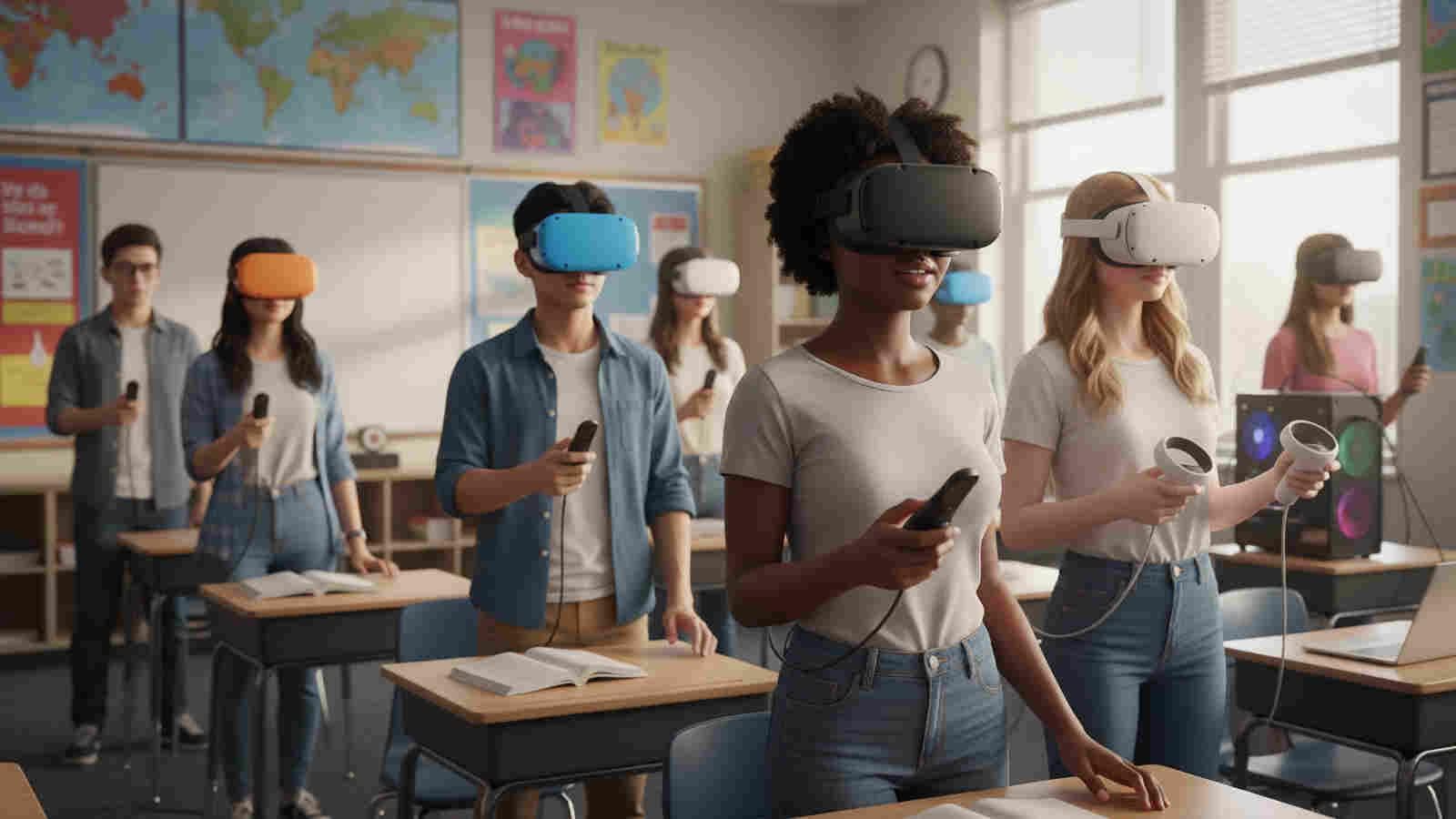
Training scars are, broadly, unintended and potentially harmful behaviours acquired through training. Suss and Arsal found that the term has been widely used in police, military and other operational training environments, but has lacked a consistent definition or framework. Their 2026 review examined 76 published and grey-literature sources, identifying 121 examples of training scars and more than 100 proposed ways of preventing or mitigating them.
The basic idea is simple.
You may think you are teaching the task, while actually teaching the training environment.
A learner may repeatedly practice something under conditions that contain artificial cues, restrictions or behaviours. Over time, those become part of what has been learned.
That matters enormously when we talk about simulation.
The relationship to VR
VR is often sold on realism.
- More realistic graphics.
- More realistic movement.
- More realistic interaction.
- More degrees of freedom.
But realism itself is not the objective.
Transfer is the objective.
The question is not simply, How closely does this look like the real world?
A better question is:
What is the learner actually learning to do, and will that behaviour still make sense when the headset comes off?
Imagine a learner repeatedly completing a task in VR because a controller vibrates at the correct moment. Or because an object conveniently snaps into position. Or because the system provides a visual cue that would never exist in the real environment.
- The training may look impressive.
- The learner may even become very good at it.
- But what exactly have they become good at?
- The task... or the simulation?
More realism can still teach the wrong thing
This is a good reminder that we need to dig deeper than “more realism.”
More technology does not automatically mean better simulation, and better simulation does not automatically mean better learning.
Sometimes the most responsible thing a simulation can do is recognize its own limits.
If VR can effectively teach recognition, sequencing, judgement, spatial understanding or decision-making, then teach those things well.
If another part of the task depends on real weight, resistance, force, touch, fine motor control or physical consequence, perhaps that part belongs somewhere else.
There is nothing wrong with saying:
This is what the simulation teaches. This is where the simulation stops.
In fact, Suss and Arsal found that proposed mitigations for training scars repeatedly converged on one principle: reduce discrepancies between practice conditions and real operational demands where possible, and when those discrepancies cannot be removed, make them explicit to the learner.
That is a remarkably useful principle for VR.
The right tool for the right part of the job
This also challenges an assumption that appears frequently in immersive technology:
If we can simulate more, we should. I am not convinced.
Perhaps the better goal is to identify exactly what needs to be learned, then choose the most appropriate method for each part.
A VR experience does not have to replicate every physical element of reality to be valuable. In some cases, attempting to do so may actually introduce new artificial behaviours that the learner must later unlearn.
Good simulation is not about reproducing everything. It is about reproducing what matters.
Training scars give us another reason to be careful about that distinction.
Sometimes adding capability improves learning.
Sometimes it simply adds another thing the learner can accidentally learn.
Sources
- Suss, J., & Arsal, G. (2026). “What are Training Scars in Police Operational-Skills Training? A Conceptual Synthesis via a Rapid Integrative Review.” Journal of Police and Criminal Psychology. The core source for the definition, examples, causes, and mitigation of training scars.
https://link.springer.com/article/10.1007/s11896-026-09825-2 - Biggs, A. T., Pistone, D., Riggenbach, M., Hamilton, J. A., & Blacker, K. J. (2021). “How unintentional cues can bias threat assessments during shoot/don’t-shoot simulations.” Applied Ergonomics, 95, 103451. Particularly relevant to the idea that learners may respond to artificial cues in a simulation rather than to the underlying real-world task.
- Aller, L., Franklin, A. E., Johnson, C. E., Gonzalez, P., & Nix, G. (2024). “Operationalizing the Healthcare Simulation Standards of Best Practice to Avoid Training Scars: An Interprofessional Exemplar.” Clinical Simulation in Nursing, 97, 101628. Useful because it shows that training scars are not just a policing issue, but a broader simulation-design concern.