…experiential learning and access to experiences that would otherwise be difficult, expensive, dangerous or simply impossible to provide.
The ability to lock-in learning by removing distractors, removing judgement, and letting focused attention flourish is equally compelling.
The list of potential benefits is extraordinarily long.
So eventually, we arrive at a different question.
What are you going to do about it?
For a school, university, training organization or education authority considering VR, there are essentially three choices.
Choice 1: Buy something
This is probably the easiest path. See an impressive demonstration. Put on a headset. Look around a beautifully rendered environment. Listen to a compelling story about the future of education. Then buy some equipment so the organization can say it has entered immersive learning.
There is nothing inherently wrong with starting somewhere.
The problem comes when the demonstration becomes the purchasing strategy. A ten-minute demo tells you very little about what happens in year three.
It does not necessarily tell you who will manage the devices, who will prepare the lessons, how many accounts will be required, how much teacher supervision is needed, whether the system depends on Wi-Fi, what happens when a subscription changes, whether the hardware remains supported, or how much professional time will quietly be absorbed keeping everything running.
Look back five years. How many times has the device changed in this short time? Then look ahead. You will be taking on that same burden, into the future.
A great demonstration proves that something can be impressive for ten minutes. It does not prove that it makes sense for five years.
That requires a different conversation.
Choice 2: Do nothing
This can feel like the fiscally responsible decision.
VR is expensive. Budgets are tight.
There are competing priorities. The apparently safe choice is to spend nothing.
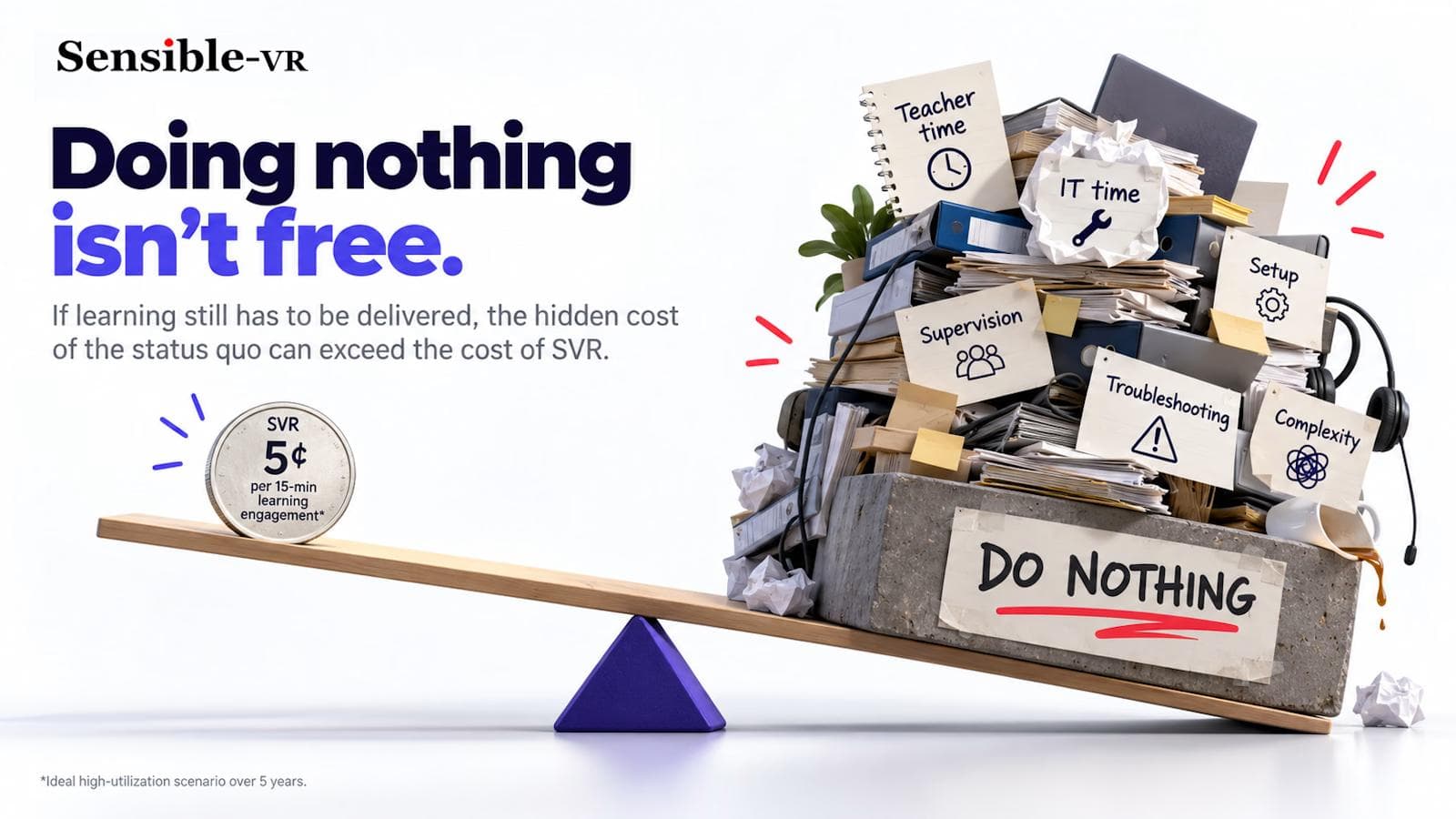
But zero is rarely the real number.
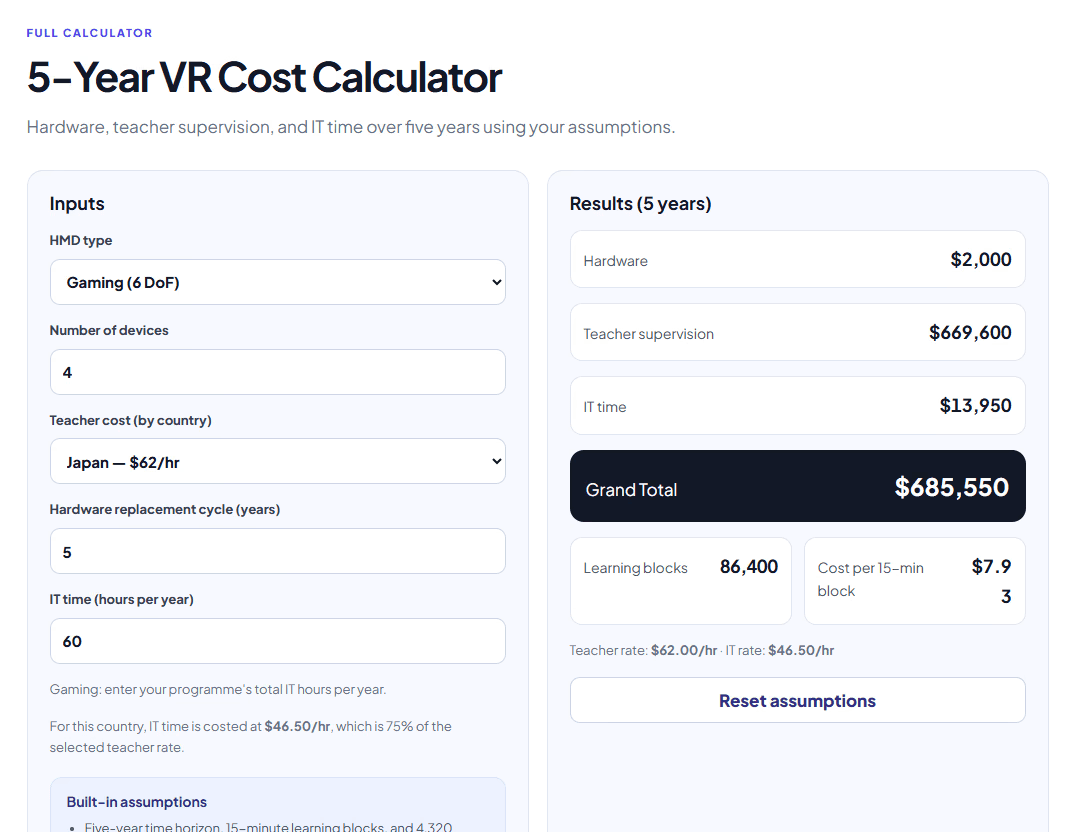
As we explored in The Cost of Doing Nothing, students still need to learn and teachers still need to deliver those learning experiences. Existing approaches consume teacher time, IT time, classroom time, preparation time and other resources, whether those costs appear on an invoice or not.
- A teacher's time does not become free because it is buried inside a salary.
- IT support does not become free because another department absorbs it.
- And inefficient delivery does not become free because nobody has bothered to calculate it.
Under a high-utilization five-year scenario, Sensible-VR can reduce the technology cost of an individual 15-minute student engagement to approximately five cents.
At a teacher cost of US$100 per hour, five cents represents less than two seconds of teacher time.
That changes the comparison considerably.
The real choice is not:
Buy VR: $X
Do nothing: $0
It is:
Invest in a system and operate it efficiently
versus
continue paying for the existing method of delivering the same learning opportunity.
Doing nothing is still a decision.
And sometimes it is an expensive one.
Choice 3: Be sensible
There is another approach.
Start with the educational value you want today, but make the purchasing decision with the next five years in mind.
Ask what the system will really cost. Not simply the headset price.
- Calculate the hardware.
- Calculate the content.
- Calculate subscriptions.
- Calculate teacher time.
- Calculate IT support.
- Calculate provisioning, charging, connectivity, device management, setup, supervision, troubleshooting and replacement.
Then ask another question:
How much educational value can this investment continue producing once it is in the school?
That is where longevity matters.
A system that delivers value this year but requires replacement, migration, new accounts, new subscriptions or an entirely different platform two years from now is not necessarily inexpensive because its original headset price looked attractive.
Conversely, an asset that can continue delivering thousands of learning engagements over many years can become increasingly economical with use.
The purchase price stays behind. The value keeps accumulating.
That is the idea of accretive value.
Every additional useful engagement extracts more educational value from an investment that has already been made.
Think beyond Year One
Education technology procurement has an unfortunate tendency to focus on acquisition. What does it cost to buy?
That matters.
But the better question is:
What does it cost to use?
And the even better question is:
What will it cost us to keep using it?
That is why Sensible-VR lays out the economics from Year 1 through Year 5.
- Hardware cost.
- Content cost.
- Teacher cost.
- Technology support cost.
- Operational cost.
Nothing important should have to hide outside the quotation simply because it makes the purchase price look better.
The headset has a price. Using it has a cost.
Schools deserve to see both.
Longevity should be designed in
There is another part of the purchasing decision that deserves far more attention.
Longevity.
Education does not operate on consumer electronics timelines.
Schools cannot reasonably redesign an immersive-learning program every time the technology industry discovers the next exciting product category, new gaming feature, fixes security flaws, or readjusts to new privacy regulations.
A sustainable education platform should be deliberately resistant to unnecessary change.
That means reducing external dependencies.
- Reducing accounts.
- Reducing connectivity requirements.
- Reducing recurring technical intervention.
- Reducing the number of things outside the school's control that must continue functioning for the learning experience to work.
Sensible-VR is completely offline by design.
The learning does not depend upon a cloud service being available at the moment a student puts on the headset.
It does not depend upon classroom Wi-Fi.
It does not require the next learner's lesson to be downloaded before use.
And the economics can be calculated across years rather than guessed at one procurement cycle at a time.
These may not be the most exciting things to demonstrate at a trade show.
They become considerably more exciting in Year 4.
So now comes the choice
The research around immersive learning is compelling. The educational possibilities are enormous. That leaves the purchasing decision.
You can buy something, because the demo looked fantastic and it feels important to get into the game.
You can buy nothing, because that appears to be the cautious financial choice, while continuing to absorb the costs of the status quo.
Or you can buy sensibly.
Choose something that provides substantial educational value today.
Know what it will actually cost to operate.
Understand where teacher and IT time will be consumed.
Remove unnecessary dependencies.
Demand transparency.
And choose an architecture capable of continuing to produce value years after the original purchasing decision has been forgotten.
Because the goal was never to own VR headsets.
The goal was to create learning.
It is time to make a choice.
The unknown.
The apparently safe option of doing nothing.
Or the economically sound, deliberately sustainable, sensible one.